7-Reel Slots in Australia: Features and RTP
 Available in AU
A practical look at reel labels, bonus conditions, paytables, free play and theoretical RTP in the context of Australian online access.

Table of Contents
- Bonus Features, With Sweet Bonanza as a Case Study
- What the Seven-Reel Label Can—and Cannot—Tell You
- Classic Reels in an Online Setting
- Real-Money Play and the Paytable Check
- Free Play Does Not Change the Randomness
- Playing in a Browser Rather Than Downloading
- A Free Session Is Not a Forecast
- Online Access Under Australia’s Gambling Rules
- RTP: Comparing Theoretical Returns, Not Individual Spins
- “Seven Reel” and “7-Reel Slots” as Search Terms
Bonus Features, With Sweet Bonanza as a Case Study
Bonus features are easiest to understand as a sequence of conditions and effects, not as promises about what a session will produce. Sweet Bonanza offers a useful case study because its free-spin trigger and multiplier bombs are described in specific terms. Those details explain how the feature is structured; they do not tell anyone what a future spin will show.
An affiliate review describes four or more scatter symbols as the trigger for ten free spins in Sweet Bonanza. The distinction matters: scatters are the symbols associated with entering the feature, while the free spins are the bonus round itself. The trigger is conditional, not a standing entitlement. Without the required scatter result, the described feature does not begin. And even when it does, the number of spins awarded is not a forecast of how much the round will return.
That trigger-and-round structure is familiar in bonus design. A feature has an entry condition, then a separate set of events that can occur once it is active. In this case, the scatter count is the entry condition; the free spins provide the setting for another mechanic. Treating the two as one event can make the feature sound simpler than it is. The scatters open the door. They do not determine what happens inside.
Choosing a reel slots site in Australia involves more than the games on offer; practical details such as payment options and licensing can also help inform your shortlist. These brief notes highlight the information available for each entry.
Payout speed: crypto under 1 hour, PayID 1-3 business days · Min. deposit: A$20 (A$30 to qualify for the bonus) Crypto withdrawals are listed as taking under an hour, while PayID withdrawals take 1–3 business days. The minimum deposit is A$20, or A$30 to qualify for the bonus.
License: Curacao Gaming Control Board OGL/2023/176/0095 (Hollycorn N.V.) Neospin is listed under a Curacao Gaming Control Board licence, OGL/2023/176/0095, held by Hollycorn N.V.
License: Curacao · Payout speed: crypto 30-60 minutes, fiat 1-5 days · Min. deposit: A$10 Wild Tokyo lists a Curacao licence, a A$10 minimum deposit, and crypto withdrawals of 30–60 minutes; fiat withdrawals are listed as taking 1–5 days.
License: Curacao Gaming Control Board OGL/2023/174/0082 (Dama N.V.) SpinsUp is listed under Curacao Gaming Control Board licence OGL/2023/174/0082, held by Dama N.V.
License: Tobique Gaming Commission · Payout speed: crypto ~10-15 minutes, fiat 1-5 days · Min. deposit: A$30 SkyCrown lists a Tobique Gaming Commission licence and a A$30 minimum deposit. Its stated withdrawal times are around 10–15 minutes for crypto and 1–5 days for fiat.
License: Curacao – Antillephone N.V. (Versus Odds B.V.) · Min. deposit: EUR 20 Thor Casino lists a Curacao licence associated with Antillephone N.V. and Versus Odds B.V. Its minimum deposit is EUR 20.
License: Curacao Gaming Authority (Jumpman Gaming Ltd) DragonSlots Casino is listed under the Curacao Gaming Authority, with Jumpman Gaming Ltd named as the licensee.
License: Curacao eGaming (Roby Games Ltd) Roby Casino lists a Curacao eGaming licence held by Roby Games Ltd.
License: Curacao OGL/2024/1335/0780 · Min. deposit: EUR 20 Vegaz Casino lists Curacao licence OGL/2024/1335/0780. The stated minimum deposit is EUR 20.
License: Curacao Gaming Control Board (TechSolutions Group N.V.) Bizzo Casino is listed under the Curacao Gaming Control Board, with TechSolutions Group N.V. named in the licensing details.
How the multiplier bombs work
During Sweet Bonanza’s free spins, multiplier bombs can appear. An affiliate review describes their values as being added together before the resulting multiplier is applied to a winning tumble. In other words, if more than one bomb appears in the relevant sequence, the values are combined rather than each being treated as an unrelated final award.
The order of operations is the useful detail. The bombs do not create a winning tumble by themselves; the multiplier applies to a tumble that has already produced a win. That makes the feature a modifier of a qualifying result, not a separate source of symbols or a guarantee that every free spin pays. It is a small but consequential distinction in how bonus rules are read.
A free-spin round can therefore contain several different layers: the original scatter condition that starts it, the spins granted by that trigger, the tumbles that may or may not form wins, and the bombs that may modify a winning tumble. These layers are sometimes flattened in casual descriptions into “a bonus,” as if the word named one predictable event. It does not. It names a framework in which several conditions still have to meet.
The phrase “multiplier bomb” also sounds more decisive than the mechanic is. A bomb can appear, but its presence does not by itself settle the outcome. Its value matters in relation to a winning tumble, and the feature remains dependent on the sequence generated during play. The rules describe what the game does when the relevant events occur. They cannot promise that those events will occur in any particular round.
What the feature does—and does not—say
Searches for bonus slots often place the entry trigger and the bonus effect side by side, as though a game with a named feature were necessarily a game with frequent or substantial payouts. That conclusion does not follow from the mechanic. A trigger explains access to a feature; a multiplier explains how a qualifying win can be adjusted. Neither tells how often the trigger arrives, how often a tumble wins, or what a particular round will return.
The free-spin label can also create a misleading sense of separation from the main game. The feature is still part of the same slot and its rules. It is not a different kind of certainty simply because the stake is not being increased during the awarded spins. The relevant description is mechanical: scatters may activate the round, and multiplier bombs may affect winning tumbles within it. Anything beyond that would turn a rule summary into a prediction.
For Australian players, an affiliate review places Sweet Bonanza’s availability at offshore-licensed casinos only. That is a description of where the game may be encountered, not an endorsement of those services. The bonus mechanics can be discussed without implying that access is locally authorised or that the feature is a reason to seek out an offshore site. A named feature remains a set of rules, not an invitation.
For Australian players, Sweet Bonanza is available only at offshore-licensed casinos.
There is a quiet social history behind the appeal of bonus rounds. They make chance legible by giving it stages: a symbol opens a door, a counter grants a run of spins, and a bomb gathers its values before a winning tumble is adjusted. The machinery acquires a little theatre. Yet the theatre does not change what the feature can establish. It explains the game’s response to a generated result; it does not explain which result comes next.
That is the boundary worth keeping in view when reading descriptions of Sweet Bonanza or any other bonus-led pokie. The stated scatter trigger and multiplier process describe conditional mechanics, and the affiliate review is the source of those particular details. They are not universal specifications for every game with free spins, nor evidence that a bonus will be reached or produce a return. The rules are specific. The next outcome is not.
What the Seven-Reel Label Can—and Cannot—Tell You
“Seven-reel” sounds like a precise classification. In practice, it tells little beyond the way a game is described: the label points to a reel-based layout, not to a guaranteed set of rules. It does not, by itself, establish how symbols are arranged, what features are present, or what a game will pay. Those details belong to the game’s own information, not to a number in its name.
That distinction matters because familiar labels invite assumptions. A person seeing “seven-reel slots” might imagine a larger version of a traditional machine, or expect a particular bonus simply because the format sounds elaborate. Neither follows from the wording alone. “Seven-reel” is a description, not a promise. It is no more a verdict on a game’s quality than a tall building’s number of floors is a guide to its architecture.

The same caution applies to free versions. “Free” describes the terms of access, not the structure of the game or the presence of particular features. A free version of a seven-reel game cannot be identified reliably from that phrase alone; the game’s own title and rules would have to do the identifying. These distinctions are useful in any market, but in Australia they sit against a legal background that makes online casino language unusually consequential.
The Interactive Gambling Act 2001 places the restriction on operators: they cannot provide online pokies to people in Australia. The prohibition does not make an individual player liable to a penalty merely for using an offshore site. That difference between the provider’s position and the player’s position is easy to flatten into a vague warning about legality. It should not be flattened. The law addresses the service being supplied, while the stated position on individual players is different.
A person must be at least 18 to play. That age condition does not turn an offshore casino into a locally authorised service, nor does the absence of a player penalty amount to official approval. Australia’s framework is a curious arrangement: the service is prohibited, while the individual is not punished for accessing it. Permission and enforcement are not the same thing.
The federal body responsible for enforcing the Act and monitoring compliance with interactive gambling laws is the Australian Communications and Media Authority, or ACMA. Its role is not to certify that a seven-reel label means anything in particular. It concerns the provision and promotion of prohibited services. Where a site supplies such a service, ACMA may ask Australian internet providers to block access to the website. The same blocking power can apply to sites advertising prohibited interactive gambling services.
Legal Restriction
Under the Interactive Gambling Act 2001, operators are prohibited from providing online pokies to people in Australia.
ACMA’s enforcement figures show the scale of that activity, though they need careful reading. The authority reports that, following enforcement actions beginning in November 2019, it has blocked more than 1,455 illegal gambling and affiliate websites. That is a count of blocked websites, not a count of games, players, or individual operators. A number can look conclusive while answering a narrower question than the one a reader might assume.
The reported number of services that have withdrawn from the Australian market since ACMA began enforcing the rules in 2017 is not consistent across accounts. One figure says more than 210; another gives more than 190. Both accounts describe withdrawals after enforcement began, but they do not provide the same count.
For anyone interpreting “seven-reel” in the name of a game, then, the useful boundary is simple: the label suggests a format, while the game’s own rules establish its specific features. It says nothing about whether an online casino service is lawful in Australia. That question belongs to the legal status of the service, not to the number of reels in its title. A neat label. A separate law.
Classic Reels in an Online Setting
“Classic” suggests a style, not a technical guarantee. In the phrase “classic seven-reel slot,” it may evoke the familiar visual language of older slot machines: reels shown in a straightforward arrangement, with the emphasis on symbols and lines rather than elaborate presentation. But the label alone does not establish how a particular game is built, what its rules are or what features it contains. A name can carry a great deal of nostalgia and very little specification.
That distinction matters online, where a traditional look can be presented on a screen without settling how the game works. The number of reels is one description; “classic” is another, usually about the impression a game gives. Neither tells the whole story. A game styled as classic might still have rules that need to be read individually, while a game with a more contemporary appearance cannot be understood from its appearance alone.
The same care applies to “seven reels.” A phrase describing a reel count does not, by itself, establish the number of paylines, the way symbols are evaluated or whether a game has bonus features. Those are separate properties. Nor does “classic” mean that a game follows one fixed historical template. The label is useful as a broad stylistic clue, but it should not be mistaken for a complete description.

Online access adds another distinction. A game’s appearance and rules are separate from the conditions under which it is offered. A free version, where available, concerns the mode of access; it does not define the game’s style, and it does not make its rules identical to those of every other title with a similar look. “Free” answers a different question from “classic.” Conflating the two turns a loose category into a promise.
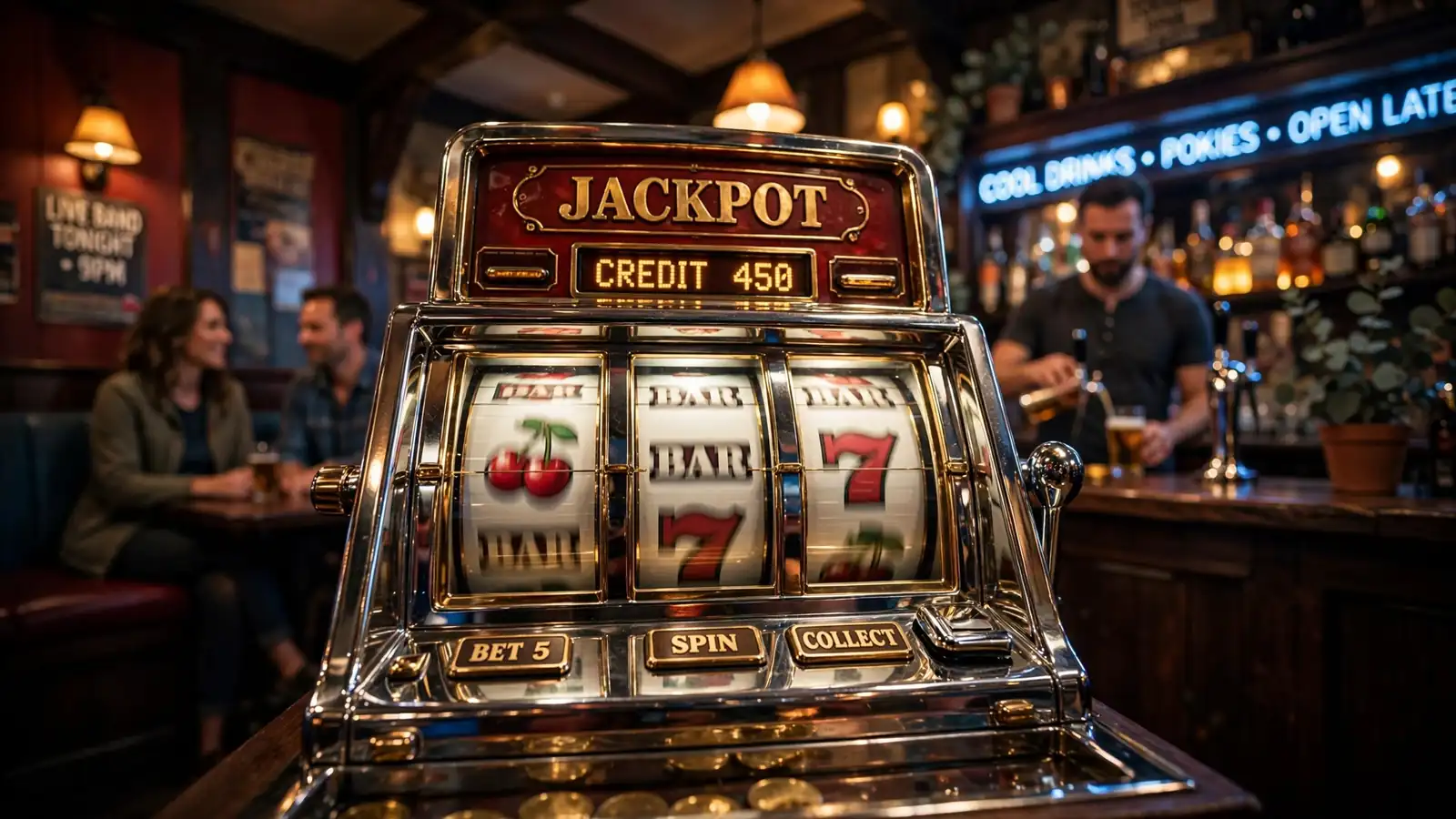
There is also a difference between seeing a traditional arrangement and reproducing the social setting that gave it meaning. A physical machine occupied a particular place: a room, a counter, a pub or a club, among people who could watch, wait or talk. On a screen, the image can suggest that older setting while leaving its surroundings behind. The visual shorthand survives; the social scene does not necessarily follow it.
Whatever the theme or presentation, the outcome of a spin is not a continuation of the one before it. Each spin is generated as a separate random event by a Random Number Generator. A run of symbols does not become more or less likely because earlier spins looked a certain way. The old-fashioned frame, if there is one, changes none of that.
For anyone sorting through games described as classic, the useful approach is to treat the phrase as an invitation to inspect, not as evidence. The game’s own rules establish what its reels and symbols do. Its general appearance cannot stand in for those details, and the word “classic” does not certify a particular format.
Nostalgia is not a rulebook.
Real-Money Play and the Paytable Check
A search for online pokies played for real money raises a practical question about the game’s information panel: which RTP applies to the version being offered? The figure is generally shown in the rules or paytable, not on the small image in a casino lobby. That distinction matters because a game title and its artwork do not identify its configured return.

A specialist review reports that an operator selects the RTP build, and that the lobby tile does not reveal which build is in use. The in-game information panel is the place to confirm the displayed figure. A percentage elsewhere on a site may describe another configuration, so it should not be treated as proof of what a particular game session is set to use.
Sweet Bonanza offers a concrete illustration of why the panel matters. A specialist review reports a typical stake range of A$0.20 to A$100 per spin, while noting that the upper limit varies by operator. That range is not a promise that every version offers those settings. The available stake controls and the RTP shown in the game itself are separate details; neither should be inferred from the game’s name or a lobby listing.
The paytable is more than a catalogue of prizes. It records the game’s terms, including the displayed RTP and the values or rules relevant to play. Checking it can clarify which configuration is presented, but it cannot turn a theoretical return into a forecast for a session. A figure in the panel describes an aggregate calculation, not what a particular sequence of spins will produce.
There is also a legal boundary that a description of game settings cannot erase. Under Australia’s Interactive Gambling Act 2001, operators cannot provide real-money online casino games to people in Australia. A page explaining where game information appears is not an invitation to wager through an offshore site; those operators sit outside Australian consumer protection, and the ACMA blocks offshore gambling domains. A paytable can disclose terms, not supply local authorisation.
The same care applies when a game is available in a free mode alongside a paid version. The free setting may expose the rules and displayed information, but it does not establish that a later paid version would use the same configuration. The panel belongs to the particular version being viewed. That is the useful distinction: a title may stay constant while the information attached to its configured build does not.
For Sweet Bonanza, then, the reported stake range is a reference point, not a universal setting, and the RTP must be read from the game’s own information panel rather than guessed from its lobby tile. The figures describe the setup being presented; they do not change the legal status of real-money online casino play in Australia. A small panel, with large implications.
- Check the in-game information panel for the RTP
- Confirm the available stake controls within the game
- Rely on the lobby tile to identify the RTP build
- Infer game settings from the title or artwork
Free Play Does Not Change the Randomness
Free play can make a seven-reel game easier to inspect: its symbols, controls and general rhythm are visible without a stake attached. That is a limited kind of familiarity, not a rehearsal for a later paid session. The game’s appearance may be the same, but a sequence of free spins cannot show what a different sequence will produce.
Online pokies use a Random Number Generator (RNG). Each spin is a separate event, not a continuation of the one before it. A win does not make another win due; a run without one does not make a win more likely on the next spin. The machinery has no memory to consult and no sense of dramatic timing.
This matters when free versions of seven-reel games are treated as tests. A free session can show how a game behaves in that session, but its outcomes do not form evidence about the outcomes of later spins. Nor does a lucky stretch establish that the game has become generous, or a poor one that it has become cold. Those are human readings of randomness, and humans are talented at finding a plot.
The theoretical return to player, or RTP, belongs to a different scale. It is a statistical measure associated with a game over a very large number of spins; it is not a promise about a short visit, free or paid. A displayed RTP describes a theoretical pattern, not a forecast for an individual session. Free play does not turn that long-run measure into a personal prediction.
The same distinction applies to searches for free seven-reel games. The number of reels identifies a visual format, while free play describes the way a session is accessed. Neither label changes the RNG’s role, and neither tells what a subsequent spin will do. A free session may offer a look at the game’s rules, but it cannot certify that a paid version will produce matching results or settle what any later run will bring.
That is the boundary worth keeping: familiarity with a game is not knowledge of its next outcome. Free play can make the interface less unfamiliar. It cannot make chance less random.

Playing in a Browser Rather Than Downloading
“ No download” describes a way of accessing a game, not a kind of game. In a browser-based setup, the game is opened through a web page; a downloadable version involves installing software first. That distinction says little about the game’s rules, its reel layout or whether it offers a free mode. Nor does it establish that a particular title will work in every browser or on every device.
The appeal of browser access is plain enough: it avoids adding a separate game application to a device. But the phrase can sound more reassuring than it is. “No download” is not a statement about who operates the service, what software runs behind the page, or what protections apply. It is a description of the route in, and a narrow one.
Free access is another separate question. A browser session might be free or involve real money; the absence of an installation does not settle that. The word “free” in a game description should therefore not be read as a technical consequence of browser access. These are different features, often pressed into the same short label.
The same restraint applies to “seven-reel” wording. A browser does not confirm the reel count, and the number of reels does not explain how a game is delivered. Search phrases can bundle these ideas together, but the interface and the game’s format remain separate matters.
Behind the display, online pokies use Random Number Generators and have theoretical RTP percentages. Those properties concern how outcomes are generated and how returns are calculated over time; they do not identify whether the game is reached through a browser or downloaded. The access method is not a clue to the odds.
In Australia, the distinction cannot turn prohibited online casino play into a permitted service. The Interactive Gambling Act 2001 bars operators from providing real-money online casino games to people in the country. A browser window changes the doorway, not the rule.
A Free Session Is Not a Forecast
A free session can make a game’s instructions easier to follow. It can show how symbols are evaluated, where the paytable sits and what the controls do, without putting a stake at risk. That is a modest kind of knowledge: familiarity with the rules, not advance notice of the result.

The distinction matters for anyone trying a seven-reel game without wagering. A sequence of wins, losses or quiet spins in a free-play mode cannot establish what a later spin will produce. Online pokies use a Random Number Generator, and each spin is a separate random event, independent of those before and after it. A run that seems to be building towards something has no memory in the mechanism. The impression belongs to the observer.
Free play is therefore useful as a tour, not as a test of future luck. It may reveal how the game presents its paytable and how its rules are organised. It cannot show that a particular pattern is due, that a dry spell is ending, or that a later paid spin will resemble the free one. Familiarity can make the interface less strange; it cannot make chance more legible.
Nor does a short session measure a game’s theoretical return. RTP is a statistical calculation about expected performance across a vast number of spins, often millions. A handful of free spins is not a miniature version of that calculation. Even a long-looking streak remains a small fragment beside the scale on which RTP has meaning.
This is why trying a game and assessing its long-run return are separate activities. The first concerns rules and presentation. The second concerns a theoretical statistic, not a promise about any individual session. Confusing them gives a brief run of random results an authority it does not possess.
The reel count does not alter that boundary. Whether a game is described as having seven reels or by another format label, free play can explain what appears on screen, but it cannot turn past outcomes into a forecast. The machinery offers no useful omen.
Online Access Under Australia’s Gambling Rules
The legal distinction is not between games with a particular reel count. It is between the kinds of services operators may provide to people in Australia. The Interactive Gambling Act 2001 prohibits Australian-licensed operators from offering online pokies, including casino services that provide pokies and table games.
Attention: An overseas licence is not an Australian authorisation, and offshore sites do not form a domestic alternative.
That makes “locally licensed online casino” a misleading description in this context. Australian-licensed operators cannot lawfully offer these games online to people in Australia. The familiar division between local and offshore platforms does not mean that offshore sites form a domestic alternative: an overseas licence is not an Australian authorisation.
A game described as a seven-reel pokie does not acquire a different legal status because of its layout. Nor does the wording used to describe its reels establish that a particular service is permitted. The relevant question is what the operator is offering and where the person accessing it is located. Australia’s rules address the online casino service, not a special class defined by the number of reels.
Free access calls for care in wording. A free session is not the same thing as a real-money gambling service, but the phrase “free online pokies” does not, by itself, establish what a site offers overall or whether that operator may provide other services to Australians. The legal restriction concerns online casino services offering pokies and table games; a label on a page cannot settle the status of the service behind it.
There is a peculiar neatness to the word “licensed” in casino advertising: it can sound like a local seal of approval when the licence is foreign. In Australia, that distinction matters. Reel count does not.
RTP: Comparing Theoretical Returns, Not Individual Spins
Return to player, or RTP, is a statistical description of a slot’s expected performance across a very large number of spins. It is not a forecast for a particular game session, nor a promise that a particular share of a stake will come back to any one person. The distinction is easy to lose because the figure is compact, precise and printed as though precision alone could make it personal.
It cannot. RTP belongs to the mathematics of repeated play, not to the story of a single visit. Its calculation considers outcomes across a vast body of spins, often millions. A short run may sit nowhere near the theoretical expectation. That is not a contradiction: a long-run average does not require each small part of the process to resemble it.
The same principle applies to games described as seven-reel slots, classic reel games or online casino pokies. The number of reels and the visual style do not, by themselves, tell anything about RTP. The figure is a separate statistical measure. A format label describes how a game is presented; RTP describes a theoretical return calculated across repeated outcomes. Confusing the two turns a visible design feature into evidence it cannot provide.
Comparisons are most useful when they stay within those limits. If two games have different RTP figures, the higher one theoretically offers a better return over time than the lower one. That is a relative statement about long-run expectation, not a ranking of what will happen in any particular session. A higher figure does not mean that the next spin is more likely to pay, that a losing sequence is due to end, or that a short run will track the calculation.
This is why the number should be read as a property of the game’s statistical design rather than a prediction of personal results. It summarises an expectation across a scale of play that no ordinary session can reproduce. The arithmetic is long-range; experience is local. The two are not interchangeable.
A comparison also needs the same kind of figure on each side. A percentage is only informative when it refers to the relevant game configuration and is understood on its own terms. A number detached from its context can look more conclusive than it is. Nor does a neat decimal make an uncertain outcome certain: the precision belongs to the theoretical calculation, not to a promise about the next spin.
The figure commonly cited as a useful point of comparison is an RTP of 96% or higher. That benchmark can help describe where a game sits in theoretical-return terms, but it should not be mistaken for a guarantee of performance in a particular period. It says nothing about whether a short session will produce a return, how quickly outcomes will arrive, or how any individual will fare. Those questions cannot be answered by a long-run percentage.
There is also a social history in the way RTP is used. Gambling has always borrowed the language of accounting: expected value, return, probability. Such language makes a game legible to institutions and consumers alike, converting uncertain events into something that can be compared on a page. It is useful, but not magical. A statistic can clarify one aspect of a game while leaving the human experience of chance untouched.
That gap matters especially when games are encountered in free form. A displayed RTP remains theoretical whether the play involves a stake or not; the number does not turn a small sample into a meaningful test of long-run performance. A brief sequence may seem generous or barren, but neither impression revises the underlying calculation. It is an experience of a run, not evidence that the long-term figure has changed.
A fair comparison therefore asks a modest question: which stated RTP is theoretically higher? It does not ask which game will pay in a particular session. The first can be answered from the figures. The second cannot be inferred from them. Treating those as separate questions avoids the familiar slide from statistical comparison into personal prediction.
The same caution applies to apparent patterns. A sequence of outcomes may invite a story—that a game is warming up, that a return is overdue, or that a recent win signals more to come. RTP supplies no support for such conclusions. Its scale is too large to function as a timetable for individual outcomes. Previous spins do not become clues to future ones merely because a percentage is printed beside the game.
A theoretical advantage remains theoretical. Higher RTP means a better expected return over time when compared with a lower RTP; it does not erase randomness or guarantee an individual result. That is the useful boundary of the figure, and also its limit. Long horizons, not single sessions.
“Seven Reel” and “7-Reel Slots” as Search Terms
The two expressions differ more in their wording than in any meaning that can safely be assigned to them. One spells out the number; the other uses a numeral and a hyphen. Neither phrasing, by itself, confirms a distinct game category, a particular layout, or a special set of rules. Treating them as names for separate formats would make typography do work it cannot support.
A label can be useful as a first clue, but it is not a specification. The number in a phrase does not establish what features a game includes, how its rules operate, or what will happen during play. Those questions require information about the particular game rather than an inference from a short description.
Nor does a reel count offer a forecast. A slot’s Random Number Generator determines each spin as a separate random event, independent of the spins before and after it. A run of results cannot turn one wording into a more reliable description of what comes next. The terminology may shift; the underlying uncertainty does not.
That distinction is modest but useful: similar labels need not indicate two verified kinds of game, and different labels do not change how individual outcomes are generated. The phrasing can help identify the subject under discussion, but it cannot substitute for the game’s own rules or predict a result. A small difference on the page, then, is not evidence of a larger difference in play. Just wording.
How do you calculate RTP in slots?
RTP is a theoretical percentage calculated over a very large number of spins, often millions. It represents the expected return over time, not the result of an individual spin.
Are there any strategies for choosing slot games based on RTP?
You can compare games’ published RTPs and look for slots at 96% or higher. Check the game’s in-game information panel, since the operator may select the RTP version and the lobby tile may not show it.
Are three-reel pokies legal for Australian players in 2026?
Australian-licensed operators cannot offer online pokies under the Interactive Gambling Act 2001. Individuals are not penalised for playing at offshore sites, but those operators are outside Australian consumer protection and ACMA may block their websites.
What is the RTP number?
RTP is the theoretical percentage of wagers a slot returns over a vast number of spins. Sweet Bonanza typically has an RTP of 96.51%, although the displayed figure can vary by version.
Is higher or lower RTP better?
A higher RTP theoretically means a better return over time than a lower RTP. It does not predict the result of any individual spin.
Published by the Big Candy Casino team.