Finding Pokies in New South Wales: Hours and Rules
 Available in AU
Venue hours, machine availability and local search results answer different questions, especially when listings are not live.
Table of Contents
- When NSW Pokies Are Open—and What the Search Can Actually Confirm
- What “Best” Means When the Games Are Built on Chance
- Online Pokies and the Australian Border That Follows an IP Address
- Pokies Near Airports, the CBD and the NSW Border
- NSW Pokies Venues: Clubs, Machines and the Local Social Map
- Why “24-Hour Pokies” Is a Question About Venue Hours
- Searching for Pokies in Parkes Without Inventing a Local Ranking
- Crown Searches and the Limits of What Can Be Verified
- CBD Clubs and the Machinery of NSW Gambling Rules
- Newcastle Searches, Cashless Claims and What the Rules Actually Say
When NSW Pokies Are Open—and What the Search Can Actually Confirm
“Open” can describe a building, a gaming area or the machines themselves. Those are not interchangeable answers. A venue’s opening hours tell when its doors are open; they do not, by themselves, establish that poker machines are available throughout that time. A listing that says a club is open early or late is therefore not a live confirmation of machine availability.
That distinction matters most when the wording is urgent: pokies open now, or machines available before the day has properly begun. Search results can surface general venue information, but a result is not a real-time view of the gaming floor. Even a current-looking opening-hours entry may answer only the question of access to the venue, not whether a particular area or service is operating at that moment.
The same applies to searches for early-morning hours. A phrase such as “open at six” or “open at seven” needs a subject: what is open, and for what purpose? A venue may have one schedule for its broader operations and different arrangements for parts of the premises. Without a direct, up-to-date confirmation from the venue, an opening time should not be treated as proof that poker machines can be played then.
Late-night searches raise the same problem in reverse. “Open late” is not a precise description of machine access, and it does not establish that machines remain available until the venue closes. The practical answer depends on the venue’s current arrangements, not on a general label attached to its name. An old listing can be especially misleading when hours change; a phone call or the venue’s own current information is more useful for confirming what is operating at the time in question.
This is less a technical distinction than an ordinary one. A restaurant can be open while its kitchen is closed; a club can be open while a particular service is not. The word “open” carries more certainty than it deserves when the thing being sought is only one activity inside a larger venue. Search language compresses those differences. Actual opening arrangements do not have to.
There is also no single statewide answer to “when are NSW pokies open?” The question is about individual venues and the conditions at a particular time, not a uniform clock shared by every place in New South Wales. A broad statement about NSW opening hours would blur together separate operations and imply a certainty that a statewide label cannot provide. The sensible check is specific: confirm the venue’s current hours, then confirm whether poker machines are available during the intended visit.
That is also why “open now” should be read cautiously. It may reflect a general listing, a venue’s stated schedule or information that has not caught up with a change. None of those necessarily confirms the status of machines on the floor at that instant. The distinction is modest, but it prevents a common mistake: arriving with an answer to the wrong question.
A separate search for an NSW pokies payout percentage belongs to a different subject. Opening hours cannot establish a payout figure, and a venue being open says nothing about the outcome of a particular machine. The time a place operates and the result of play are not connected measures. One is about access; the other concerns the game. Mixing them makes a search result look more informative than it is.
There is one clear age rule for poker-machine gambling in NSW: a person must be at least 18. That is a condition of participation, not a guide to opening hours. The distinction reflects the way gambling is treated in public life: access is not simply a matter of finding a door that happens to be open. Age is a legal boundary, while operating schedules are venue-specific.
So an NSW opening time should be treated as a starting point, not a promise about machine availability. Confirm the venue’s present schedule and ask specifically whether poker machines are operating at the time planned. It is a small act of precision in a search landscape where one short word—“open”—is doing rather too much work.
What “Best” Means When the Games Are Built on Chance
Choosing pokies for New South Wales in 2026 starts with checking the details that matter to you, such as licensing and payment terms. This list offers a concise reference point for reviewing the available operator information.
Payout speed: crypto under 1 hour, PayID 1-3 business days · Min. deposit: A$20 (A$30 to qualify for the bonus) Ricky Casino lists crypto payouts under 1 hour and PayID payouts in 1–3 business days. The minimum deposit is A$20, or A$30 to qualify for the bonus.
License: Curacao Gaming Control Board OGL/2023/176/0095 (Hollycorn N.V.) Neospin lists a Curaçao Gaming Control Board licence, OGL/2023/176/0095, held by Hollycorn N.V.
License: Curacao · Payout speed: crypto 30-60 minutes, fiat 1-5 days · Min. deposit: A$10 Wild Tokyo lists a Curaçao licence, with crypto payouts in 30–60 minutes and fiat payouts in 1–5 days. Its minimum deposit is A$10.
License: Curacao Gaming Control Board OGL/2023/174/0082 (Dama N.V.) SpinsUp lists a Curaçao Gaming Control Board licence, OGL/2023/174/0082, held by Dama N.V.
License: Tobique Gaming Commission · Payout speed: crypto ~10-15 minutes, fiat 1-5 days · Min. deposit: A$30 SkyCrown lists a Tobique Gaming Commission licence. Its stated payout times are around 10–15 minutes for crypto and 1–5 days for fiat; the minimum deposit is A$30.
License: Curacao – Antillephone N.V. (Versus Odds B.V.) · Min. deposit: EUR 20 Thor Casino lists a Curaçao licence through Antillephone N.V. (Versus Odds B.V.). Its minimum deposit is EUR 20.
License: Curacao Gaming Authority (Jumpman Gaming Ltd) DragonSlots Casino lists a Curaçao Gaming Authority licence held by Jumpman Gaming Ltd.
License: Curacao eGaming (Roby Games Ltd) Roby Casino lists a Curaçao eGaming licence held by Roby Games Ltd.
License: Curacao OGL/2024/1335/0780 · Min. deposit: EUR 20 Vegaz Casino lists a Curaçao licence, OGL/2024/1335/0780. Its minimum deposit is EUR 20.
License: Curacao Gaming Control Board (TechSolutions Group N.V.) Bizzo Casino lists a Curaçao Gaming Control Board licence held by TechSolutions Group N.V.
The phrase “best paying pokies” suggests a ranking that the machinery cannot honestly provide. A game may have a memorable name, elaborate graphics or a bonus round that feels unusually generous; none of those qualities establishes what it will pay during a particular session. In NSW, as elsewhere, the distinction between an entertaining design and a reliable source of returns is not a small one. It is the whole matter.
Every online pokie uses a Random Number Generator, or RNG, to determine its results. Each spin is independent: the RNG does not keep a tally of earlier outcomes, and a run of losses does not make a win due. Nor does a recent win make the next one less likely. The sequence may look as though it is telling a story. The machinery is not listening.
That is why past spins cannot identify the best pokies in NSW, whether the games are being compared by name or by recent performance. A screen may show a history of results, but that record describes what happened, not what must happen next. Increasing a bet to recover losses gives the next wager no special advantage; it simply puts more money at risk. Chasing losses is not a strategy. A session budget grounded in the available bankroll is a boundary, not a prediction.
- Set a session budget based on your available bankroll
- View a budget as a strict boundary
- Increase bets to recover losses
- Treat chasing losses as a strategy
RTP, or return to player, offers a different kind of information. It is a theoretical measure of how much of the money wagered a pokie pays back across a very large number of spins. It does not promise that a particular player will receive that share, or that a short session will resemble the long-run calculation. A game with a higher RTP is not a machine that can be expected to pay more on demand. The timescale matters. So does the word “theoretical”.
The names in a game lobby can invite their own kind of ranking. Dragon Link, Lightning Link, Wolf Treasure, Book of Ra, Gonzo’s Quest, Mega Moolah and Starburst are recognisable titles, but a title alone says nothing about the result of the next spin. Themes and visual effects are part of presentation; they do not reveal whether a game is likely to pay during a given visit. Familiarity is not evidence of an edge.
Progressive jackpot pokies work differently in one visible respect: a small portion of each bet contributes to a growing jackpot. That explains how the prize pool can increase. It does not establish when it will be won, or make the next spin more promising. The larger prize attracts attention; the underlying uncertainty remains.
Some games also offer a buy-bonus feature, letting a player pay a set amount to enter a bonus round directly. A report on psu.com described such prices as commonly falling within a particular multiple of the stake, but that is not a dependable rule for every game or current offer. More importantly, buying entry changes how the bonus is reached, not the basic fact that outcomes are uncertain. A direct route is still a wager.
So “best” can sensibly refer to a feature a player values—perhaps the pace, presentation or structure of a game—provided it is not mistaken for a forecast of returns. It cannot mean a title proven to pay most in the next session. No theme can do that work. No streak can either.
Attention: No theme or streak can forecast returns, and the “best” pokie cannot be defined by a proven ability to pay in the next session.
A limit can be useful precisely because the game cannot promise an outcome: decide what the session can cost, and do not raise the stake to repair a loss. The machines offer suspense, not a ledger that settles in the player’s favour. That is the distinction.
Online Pokies and the Australian Border That Follows an IP Address
An online casino does not need to know where a player grew up to make a regional decision. It can read the internet address of the device being used and infer the country from which it connects. That digital border may decide whether a game appears at all: when a title is blocked for Australian access, it will not show in the game lobby from an Australian IP address. A game that fails to load may also be encountering a regional restriction, rather than a technical fault.
The distinction matters because a catalogue can look different from one location to another. Casinos and game providers may exclude countries under the terms of their licences, and a platform can block access by filtering IP addresses associated with those places. For someone comparing online pokies while physically in NSW, a game’s presence on a site described elsewhere does not establish that it is available locally. Nor does a large catalogue prove anything about which games are accessible from an Australian connection.
The legal boundary is less ambiguous than the catalogue. The Interactive Gambling Act 2001 prohibits operators from providing real-money online casino games, including pokies, to people in Australia. An Australian-run online casino therefore cannot lawfully offer those games to customers here. All gambling sites operating lawfully in Australia must hold an ILGA licence, but that is not a route by which an online casino can lawfully offer prohibited games to Australian residents.
Offshore services occupy a different, uneasy position. Australian players are not criminally liable merely for using an offshore casino, but those platforms are not regulated under Australian law, and their provision of real-money casino games to people here remains prohibited. The difference between a player’s exposure and an operator’s legal position is real; it should not be mistaken for a local consumer guarantee. A foreign licence does not turn an offshore site into an Australian-regulated service.
That gap becomes practical when something goes wrong. Dispute resolution may be limited, and winnings may not be protected if an operator becomes insolvent. A site’s bonus terms can also contain substantial wagering conditions, cashout caps or clauses that allow winnings to be voided. A “no deposit” offer is still a contract written by the operator, not evidence that the resulting balance can be withdrawn freely. No bonus changes the underlying legal or financial risks.
A VPN can make a connection appear to come from another country, but it does not move the player or change the law applying to them. A specialist review has described VPN use as a way of altering apparent digital location; using one to reach region-blocked games can breach a site’s terms and lead to account suspension. The operator may also refuse access or challenge a withdrawal. It is a poor substitute for protection.
Searches for online pokies near NSW, high-limit games or a no-deposit bonus can make a remote service seem as locally available as a venue down the road. The interface encourages that impression. The legal and technical arrangements do not support it: access can be restricted by IP, and offshore platforms lack the protections of Australian regulation. A familiar screen is not a local safeguard.
Legal Risks
Using a VPN to access region-blocked games can breach a site’s terms, leading to account suspension or refusal of withdrawals.
Pokies Near Airports, the CBD and the NSW Border
A venue’s position on a map can answer only part of a location question. Searches for pokies near an airport, in central Sydney or close to the NSW–Victoria border may suggest a tidy list of nearby options. But proximity alone does not establish that a venue has poker machines, that they are available at a particular time, or that the location suits a particular journey. Those details need current, venue-specific confirmation.
Airports make distance especially easy to misread. A venue described as being near an airport could still be inconvenient to reach, depending on terminals, roads, transport connections and the precise location meant by “near”. Nor does an airport-related search establish that poker machines are located inside the airport itself. Without confirmed venue information, naming a club or casino as an airport option would turn a phrase into a recommendation without a reliable basis.
The same caution applies to the CBD. Central business districts are not a single point on a map, and a venue’s presence somewhere in a city does not make it a CBD venue. A useful check separates the claimed location from the service being sought: the address, whether the venue has Electronic Gaming Machines, and whether those machines are available under its current arrangements. These are distinct questions, not interchangeable map pins.
Border searches add another wrinkle. “Near the NSW border” could mean a town on either side, a route through the region, or a stop close to a crossing. State lines do not make nearby venues equivalent, and a result in Victoria is not a NSW venue merely because the journey between them is short. The relevant jurisdiction follows the venue’s actual location. For a NSW venue, the legal age for gambling on poker machines is 18.
Distance is also a poor substitute for availability. A map listing may establish an address, but it cannot by itself confirm machine access, current operating arrangements or whether the venue remains a practical stop. A location result is a lead, not a live status report. That distinction matters most when a trip depends on a brief stop or a particular route.
There is a social map beneath the geographic one. Airports serve people in transit; CBDs gather workers, residents and visitors; border towns sit between local routines and through-traffic. A venue can occupy any of these settings without being a useful choice for every person passing through. The surrounding district says something about movement and habit, but it does not certify what is inside.
NSW venues must check identification for poker machine gambling, and the age threshold is not a formality to be guessed at from appearance or circumstance. Gambling below the legal age can have legal consequences. Responsible play also means setting a session budget in advance and not raising bets to recover losses. A nearby venue does not make losses easier to undo.
For airport, CBD or border-area plans, the soundest approach is to confirm the specific address and machine availability directly with the venue before travelling. Without that confirmation, “nearby” remains a matter of map scale, not a dependable promise.
Visit Planning
- Confirm the specific address of the venue
- Verify if the venue has Electronic Gaming Machines
- Confirm machine availability for the planned time of visit
NSW Pokies Venues: Clubs, Machines and the Local Social Map
In New South Wales, a club is more than a building with Electronic Gaming Machines (EGMs). The word carries the suggestion of membership, shared rooms and local life: a place organised around sport or community, where gaming may sit alongside other activities. That social setting helps explain why a search for a “best” pokies venue cannot be settled by machine count alone. A venue’s scale is one kind of comparison; what makes it suitable for a particular person is another.
There is one clear statewide marker. Among NSW clubs, Club Liverpool leads in the number of poker machines currently operating. That makes it a measurable point of reference for scale, not a verdict on atmosphere, service, accessibility or the quality of a visit. Nor does it establish that the club is the best venue for everyone. A count can describe the size of a gaming floor. It cannot describe the people gathered around it.
That distinction matters because clubs occupy an unusual place in public life. They combine a commercial operation with the language and rituals of belonging. A local name on a sign may evoke a sporting side, a neighbourhood or a social circle; the gaming room is part of that landscape, but not its whole meaning. The machine count is easier to publish than the social map around it.
For anyone comparing NSW pokies venues, a useful approach is to separate what can be measured from what remains personal. The number of machines gives a concrete scale comparison where that information is available. It does not show how busy a room feels, what other facilities a club offers, or whether its setting suits an individual. Those details need to be checked with the venue rather than inferred from a ranking.
The comparison also sits within the state’s rules. Gambling on poker machines is restricted to people aged 18 and over, and venues must check identification for this activity. Non-compliance can carry legal consequences. NSW also requires players to set a loss limit through a pre-commitment system before playing. These safeguards do not turn a club into a risk-free environment; they mark the boundary between organised access and unrestrained play.
A social outing can make spending feel less solitary, but it does not change the chance-based nature of gambling. A budget for a session should come from money that can be lost without affecting essentials, and losses should not be chased by raising bets. Groceries and rent are not problems a gaming room can solve.
So Club Liverpool’s position is useful, but narrow: it is the largest club-machine operation by the stated measure. The “best” venue remains a judgement about more than size, and no single count can make it on behalf of the whole state.
Why “24-Hour Pokies” Is a Question About Venue Hours
The phrase “24-hour pokies” sounds as if it describes a machine. In practice, the first question is about the venue around it: whether the club or casino is open, and whether its gaming area is operating at that time. A building’s advertised hours do not, by themselves, establish that poker machines are available throughout them.
A venue’s general opening hours do not automatically guarantee that the gaming area or poker machines are available throughout that entire period.
Opening schedules are venue-specific and can change, so a claim of continuous access needs confirmation from the venue close to the time in question. A listing that simply labels a place “open now” may describe its general premises, not the status of its gaming facilities. The distinction is small on a screen and rather larger at a locked door.
This is why requests for 24-hour venues, current availability and NSW pokies opening hours are not interchangeable. One asks about a schedule; another asks whether a particular venue is operating at a particular moment. Neither can be answered responsibly by treating “24-hour” as a property of the machine itself.
Nor does New South Wales’ pre-commitment system set a venue’s timetable. Before playing, a person must set a loss limit through the system. That limit concerns the conditions of machine play, not whether the doors are open or when the machines can be used. It is a boundary around spending, not a promise of uninterrupted access.
The system also makes a distinction worth keeping: a limit selected before play can shape what happens during a session, but it cannot turn gambling into a dependable source of income. Increasing bets to recover losses only puts more money at risk. A session budget should be set in advance and kept separate from money needed for ordinary expenses; losses should not be chased.
Entry and machine use are also subject to age and identification checks. Poker-machine gambling in NSW is for adults aged 18 and over, and venues are expected to check identification. Those rules sit alongside the pre-commitment requirement, but none of them confirms a venue’s hours.
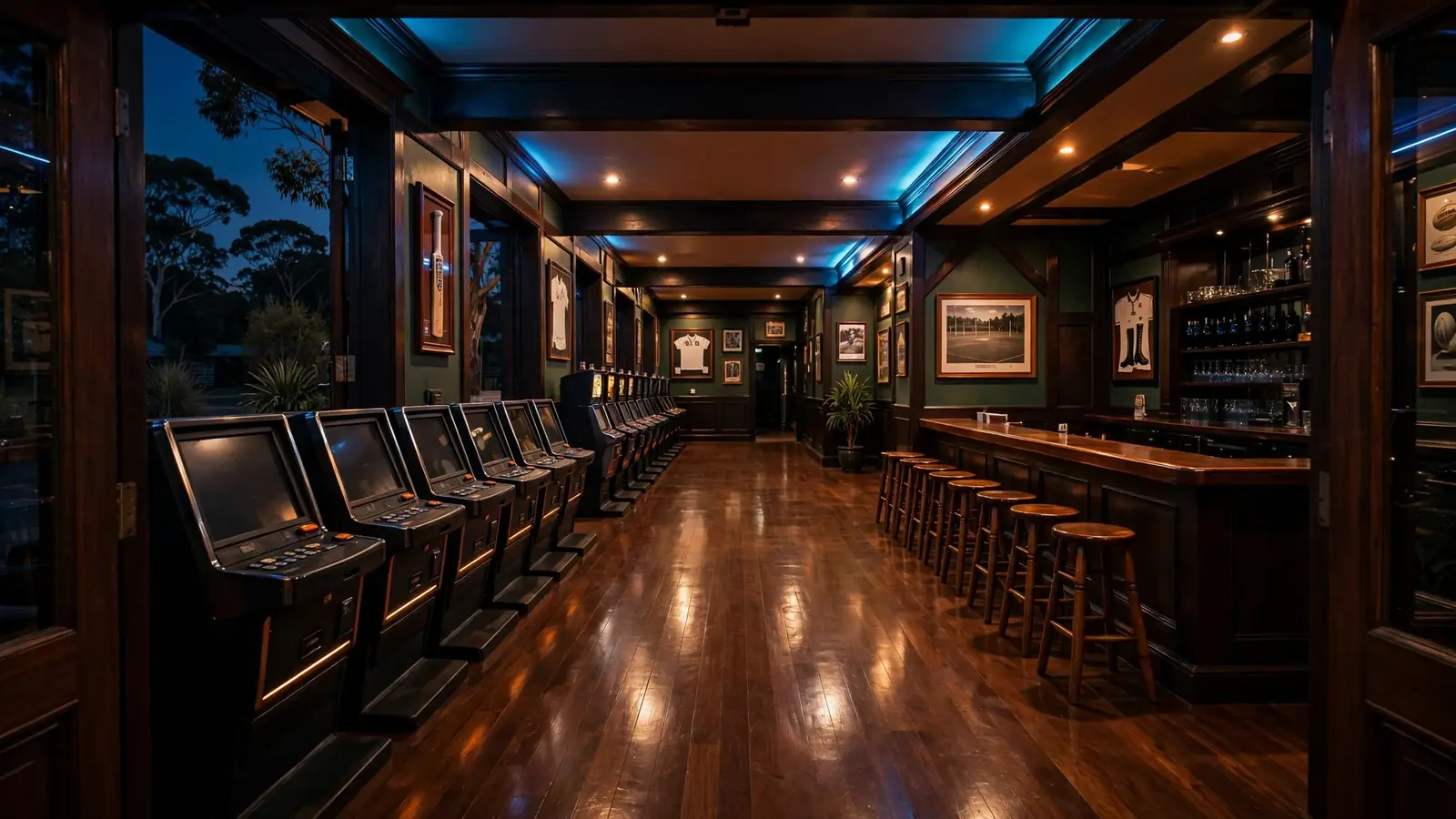
So a claim about round-the-clock pokies needs two separate checks: the venue’s current opening information and whether its gaming area is available at that time. The search phrase alone settles neither. A timetable is not a guarantee.
Searching for Pokies in Parkes Without Inventing a Local Ranking
A list of pokies venues in Parkes would need local evidence: which venues operate poker machines and how their machine offerings compare. A place name in a heading cannot supply either. Without those details, calling one Parkes venue the best would turn a location into a verdict without showing the grounds for it.
There is a useful NSW-wide point of comparison, but it has a narrow meaning. Club Liverpool has the largest number of operational poker machines among clubs in the state. That says something about its position in the statewide club tally; it does not establish anything about the number of machines in Parkes, or identify the best local venue. Scale and quality are different measures.
That distinction matters because “best pokies in NSW” can suggest a single league table where none is implied by the available comparison. A machine count concerns quantity, not what games a venue offers, whether a particular game is available, or what any individual player might experience. Nor does a statewide fact become a local ranking merely because Parkes is also in NSW.
The same care applies when considering nearby towns. Port Macquarie and Parkes are separate local searches, not interchangeable evidence. A comparison between them would require information about venues in each place; one town’s name cannot stand in for the other’s facilities or machine count.
Statewide Comparison
Club Liverpool currently leads among NSW clubs in the number of operational poker machines. This serves as a measure of scale for the state, but does not establish local rankings for towns like Parkes.
For someone trying to make a practical decision, the sensible distinction is between a confirmed venue detail and a broad claim. A venue’s own current information can help establish whether it has poker machines and what facilities it describes. A claim that it has the most, the best selection, or a particular standing in Parkes needs a basis that actually compares local venues. “Popular” is not a measurement, and a statewide machine total would not fix that.
This is less satisfying than a ranked list, but more honest. Parkes deserves local information, not a borrowed ranking dressed up as local knowledge. The statewide Club Liverpool comparison can be stated clearly; it cannot do the work of a Parkes machine count.
A search for pokies in Parkes, NSW, may lead to pages that use confident labels. The useful test is whether the claim concerns a named local venue and is supported by current, comparable details. Without that, “best” is decoration. A town is not a leaderboard.
Crown Searches and the Limits of What Can Be Verified
Crown-related searches can point to several different things: a casino venue, a particular room, or a game someone expects to find there. Those are not interchangeable. A familiar name does not, by itself, confirm which pokies are available, what a particular room contains, or what its operating arrangements are. Venue-specific details need to be checked with the venue and may change.
The same caution applies to “best”. A room can be judged by atmosphere, layout or the range of games on offer, but none of those qualities can establish that its pokies will return more to one person than another. Nor does the word “maximum” in a question about cash payouts identify a payout amount. A game’s title, setting or reputation is not evidence of a particular result.
For online pokies, the mechanism is less theatrical than the imagery. Each game uses a Random Number Generator, and each spin is independent: an earlier run of wins or losses does not set up the next outcome. The machine has no memory in the human sense. It does not owe a player a correction after a losing streak, or owe the house a win after a payout. The symbols may tell a story. The sequence does not.
That distinction matters when a search names a particular operator. General information about how online pokies work cannot confirm that a specific game is available under a Crown name, at a particular venue, or in a particular room. A title seen elsewhere is not proof of local availability, and a venue name is not a game catalogue.
The practical answer to Crown-specific questions is therefore narrower than the phrasing may suggest: confirm the venue and its current offerings directly, and treat claims about particular games or payout arrangements as claims requiring their own evidence. This is not a ranking of rooms, nor a promise about what a machine might pay. It is a boundary between what a name evokes and what it proves.
Chance remains indifferent to branding.
CBD Clubs and the Machinery of NSW Gambling Rules
Central Sydney searches for club pokies tend to blur two different questions: where a club is, and what rules govern its machines. A CBD label is not evidence of a particular venue’s location, machine offering or suitability. No specific central-city club can be recommended on that basis.
NSW Gambling Rules
- Poker machine gambling is restricted to individuals aged 18 and over
- Venues are required to check identification for participants
- Players must set a loss limit through a pre-commitment system before playing
- All gambling sites operating in Australia must hold an ILGA licence
One statewide comparison is clearer. Club Liverpool has more operational poker machines than any other club in NSW. That fact belongs to the state’s club landscape; it does not place the venue in Sydney’s CBD. Geography has its own stubborn rules.
Clubs occupy an unusual place in Australian social life. They are not simply rooms containing Electronic Gaming Machines (EGMs): they are local institutions, often organised around sport, community and hospitality. The machines sit inside that civic setting, but the setting does not alter the chance involved or make gambling a reliable source of income. Nor does a club’s status exempt it from gambling rules.
In NSW, poker machine gambling is restricted to people aged 18 or older. Venues must check identification, and underage gambling is unlawful. All gambling sites operating in Australia must hold an ILGA licence to provide lawful services; that requirement should not be mistaken for permission to offer prohibited online casino games.
A further rule changes the shape of play before it begins. NSW requires a pre-commitment system: a player sets a loss limit before using a machine. It is a formal boundary, not a forecast of what a session will cost, and it does not guarantee that the limit will feel easy to keep. The machinery of gambling includes both the machine and the rules around it.
For anyone seeking to step away, self-exclusion is a separate subject from setting a loss limit. The two should not be treated as interchangeable: pre-commitment sets a boundary for play, while exclusion concerns not gambling at a venue or across venues. Details of available exclusion arrangements should be confirmed with the relevant NSW authority or venue, rather than inferred from the pre-commitment rule.
That distinction matters in a city where a club can be both a meeting place and a gambling venue. A central location, a familiar name or a community role cannot establish that its pokies are “best”. It can only describe the place; the rules describe the conditions under which play is permitted.
Newcastle Searches, Cashless Claims and What the Rules Actually Say
A Newcastle venue’s reputation and its payment arrangements are separate matters. Calling a pokie “cashless” describes how money is put into play or handled; it does not establish that the machine has a particular payment system, nor does it identify a venue where that system is in use. A label can travel faster than the detail behind it.
The NSW rule that is clear concerns pre-commitment. Players must set a loss limit before playing poker machines. That requirement is about deciding in advance how much loss to accept. It does not, by itself, mean that machines take no cash, use a particular card or app, or operate without notes and coins. Those are distinct features, and one cannot be inferred from the other.
This distinction matters in Newcastle as much as elsewhere in the state. A venue’s general description, a photograph of a machine, or a claim about cashless gaming would need to be checked against current information about that specific venue and its equipment. Statewide pre-commitment rules are not evidence of local payment technology.
“Best” is equally dependent on what is being compared. It might refer to a club’s setting, the range of games, accessibility, or the payment arrangements available; none of those qualities follows from a cashless label alone. Nor does the presence of pre-commitment settle the question. It describes a safeguard built around a limit, not a ranking of venues or a promise about how a session will unfold.
The language can sound interchangeable because both systems involve money and decisions made around play. They are not interchangeable. One sets a boundary on losses; the other concerns the way funds are handled. Confusing them turns a regulatory condition into a feature claim.
For Newcastle, the useful distinction is plain: NSW requires pre-commitment for poker-machine play, while cashless operation is a separate claim that needs venue-specific confirmation. A state rule cannot do the work of a local description.
Written by the editors at Big Candy Casino.