
Real Cash Online Pokies in Australia: Bitcoin Explained
 Available in AU
Bitcoin pokies combine slot-game software with cryptocurrency payments, but game credits are not the same as Bitcoin held in a wallet.

Table of Contents
- Bitcoin Pokies: A Digital Game, Not a Cash Machine
- The Australian Legal Boundary Around Real-Money Play
- Free Play and Real-Money Play Are Different Modes
- Game Credits, Bitcoin Value and the Meaning of a Win
- Casino Apps and the Question of Getting Paid
- Deposits, No-Deposit Offers and Bonus Disputes
- Real Money Online: What Bitcoin Changes—and What It Does Not
- Free Spins, Real Winnings and the Limits of the Claim
- Bitcoin Withdrawals: Addresses, Fees and Waiting
- When a Win Becomes a Verification or Security Review
Bitcoin Pokies: A Digital Game, Not a Cash Machine
“Bitcoin pokies” describes digital slot-machine games that accept Bitcoin as a payment method. The phrase joins two things that can look deceptively similar on a screen: a game built around spins and symbols, and a cryptocurrency with a market value outside the game. They are not the same kind of thing.
The game is software. Its reels, symbols and displayed balance belong to the game’s own design. Bitcoin, by contrast, is a cryptocurrency transferred between digital wallets. When an interface shows a balance during play, that figure may represent game credits rather than a quantity of Bitcoin sitting in a wallet. A screen can make the distinction easy to overlook; it cannot erase it.
That is why “real cash” is an uncertain label in this setting. It may suggest that a balance behaves like ordinary money, ready to be spent anywhere. Game credits do not have that general purchasing power. They are units used within a particular game, and their relationship to Bitcoin is not necessarily fixed. A specialist review has described their Bitcoin value as dependent on the game and the current BTC price. That account is a useful qualification, not a promise that every game displays or handles value in the same way.
Choosing real-cash online pokies in Australia calls for checking practical details such as payment options and licensing information. These operator notes highlight the facts available to help inform your choice.
Payout speed: crypto under 1 hour, PayID 1-3 business days · Min. deposit: A$20 (A$30 to qualify for the bonus) Ricky Casino lists crypto payouts in under an hour and PayID payouts in 1–3 business days. The minimum deposit is A$20, or A$30 to qualify for the bonus.
License: Curacao Gaming Control Board OGL/2023/176/0095 (Hollycorn N.V.) Neospin is licensed by the Curacao Gaming Control Board under OGL/2023/176/0095, with Hollycorn N.V. named as the licensee.
License: Curacao · Payout speed: crypto 30-60 minutes, fiat 1-5 days · Min. deposit: A$10 Wild Tokyo lists crypto payouts in 30–60 minutes and fiat payouts in 1–5 days. Its minimum deposit is A$10, and its license is listed as Curacao.
License: Curacao Gaming Control Board OGL/2023/174/0082 (Dama N.V.) SpinsUp is licensed by the Curacao Gaming Control Board under OGL/2023/174/0082, with Dama N.V. named as the licensee.
License: Tobique Gaming Commission · Payout speed: crypto ~10-15 minutes, fiat 1-5 days · Min. deposit: A$30 SkyCrown lists crypto payouts in approximately 10–15 minutes and fiat payouts in 1–5 days. Its minimum deposit is A$30, and its license is from the Tobique Gaming Commission.
License: Curacao – Antillephone N.V. (Versus Odds B.V.) · Min. deposit: EUR 20 Thor Casino is listed as licensed in Curacao through Antillephone N.V. (Versus Odds B.V.). Its minimum deposit is EUR 20.
License: Curacao Gaming Authority (Jumpman Gaming Ltd) DragonSlots Casino is listed under a Curacao Gaming Authority license, with Jumpman Gaming Ltd named in connection with it.
License: Curacao eGaming (Roby Games Ltd) Roby Casino is listed as licensed by Curacao eGaming, with Roby Games Ltd named in connection with it.
License: Curacao OGL/2024/1335/0780 · Min. deposit: EUR 20 Vegaz Casino is listed with a Curacao license, OGL/2024/1335/0780. Its minimum deposit is EUR 20.
License: Curacao Gaming Control Board (TechSolutions Group N.V.) Bizzo Casino is listed as licensed by the Curacao Gaming Control Board, with TechSolutions Group N.V. named in connection with it.
The word “pokies” is familiar in Australia, where it carries the history of a distinctly local term for electronic gaming machines. Online, the setting changes but the basic image remains: a player sees a game interface, makes a stake within its rules, and watches symbols resolve. Adding Bitcoin changes the payment vocabulary, not the nature of the game. The machine is still digital entertainment with a financial element, not a private bank account wearing a brighter costume.
This distinction matters whenever a page describes real cash online pokies or a real cash online casino. Those phrases may be used to distinguish wagering from free play, but they do not establish that every displayed amount is cash, that a result has a stable Bitcoin value, or that funds are freely transferable. A game balance is an interface reading. Its meaning depends on how the game defines credits and how the operator handles them.
Nor does the label “Bitcoin” make a game anonymous or outside ordinary scrutiny. It identifies a payment method, not a guarantee about the operator, the game’s rules or what a displayed balance represents. The language of digital money can lend an old form of gambling a technical sheen. The underlying distinction remains plain: a game credit is a unit in a game; Bitcoin is a cryptocurrency.
In Australia, descriptions of real-money online pokies must also be read against the country’s legal setting. The term is not an endorsement or an indication that a locally authorised real-money casino is available. Any discussion of gambling with money concerns adults aged eighteen or older, and the game’s terminology does not change the legal status of the service.

This page is affiliate material and may contain sponsored links. Such a disclosure describes the page’s commercial relationship; it does not turn a description into a recommendation. A cash machine dispenses money. A digital game displays rules, symbols and balances. Confusing the two is easy. Costly, too.
The Australian Legal Boundary Around Real-Money Play
Australia draws a firm line around online casino games for money. Under the Interactive Gambling Act 2001, operators must not provide real-money casino services to people physically located in Australia. That prohibition includes pokies, poker and table games. A website’s availability, its currency options or the language on its pages does not change the legal boundary.
This can make the phrase “online real cash pokies in Australia” sound more settled than the reality. There is no locally licensed online casino market in which residents can legally be offered real-money pokies. The distinction is between what an overseas website may claim about its own licence and what Australian law permits an operator to provide to someone in Australia. Those are not the same thing.
The law places the central prohibition on providers. It is not a statement that a player faces a fine or criminal prosecution simply for accessing an offshore site. But the absence of player liability is not an endorsement, nor does it turn an overseas casino into a locally regulated service. The country has chosen to restrict the supply of real-money online casino games rather than build a domestic licensing system for them. A boundary, not a welcome mat.
Legal Boundary
Under the Interactive Gambling Act 2001, operators must not provide real-money casino services to people physically located in Australia.
What an offshore licence means
The operators discussed in this context hold offshore licences, primarily from Curacao eGaming or the Anjouan Gaming Authority. Those licences are issued outside Australia. They do not give an operator permission under Australian law to offer online casino games for real cash to people located here.
That difference matters because a licence can sound like a portable credential: a seal that travels with a business wherever its website can be opened. In practice, a foreign regulator’s oversight is not Australian oversight. An offshore licence does not make an operator locally licensed, and it does not supply the protections or remedies associated with Australian consumer law. Australian consumer protection laws do not apply to the offshore operators discussed.
The gap is more than a question of paperwork. If a dispute arises, an Australian resident cannot assume that domestic consumer protections will govern the operator’s conduct or provide a route to a remedy. The operator’s own terms and the rules of its licensing jurisdiction may shape the dispute instead. A badge on a website can identify who claims to supervise a business; it cannot erase the distance between that authority and the customer.
For the same reason, “licensed” should not be treated as shorthand for “authorised in Australia.” The offshore licences named here indicate where those operators are licensed, not that Australia has approved their services. In this market, that distinction is the whole point.
Age and the limits of protection
Real-money gambling is for adults aged 18 or over. That threshold is a minimum age condition, not a legal route around the prohibition on operators providing online casino games to people in Australia. Being an adult does not make an offshore service locally authorised.

This matters particularly when a page uses familiar language such as “real cash casino games” or “win real cash.” Such phrases describe a commercial claim, not a legal status. The words can make the activity sound ordinary, almost like another online purchase. Yet a claim about playing for money does not establish that the service may lawfully be supplied in Australia, or that a resident has the protections they might expect from a domestic business.
The policy choice has a social history. Gambling has long been regulated through distinctions about who may offer it, where it may be offered and what oversight accompanies it. Online services strain those older borders: a website may be operated abroad while its intended audience sits at home. Australian law responds by prohibiting operators from supplying real-money online casino games to people in the country. The internet makes the boundary less visible, not less real.
This page is affiliate material and may include sponsored links. That disclosure does not change the legal position, make an offshore operator Australian-authorised, or amount to a recommendation to use one. Commercial language and legal status remain separate matters. The distinction is not fine print.
Free Play and Real-Money Play Are Different Modes
Online pokies may be presented in free-play mode or in real-money mode. The screen can look much the same in both: reels turn, symbols land, and a balance changes. What differs is the condition of play. In free play, the balance is for trying the game, not a sum that can be withdrawn. A displayed result in that mode does not become cash merely because it resembles a win.
Mode Distinction
Free play allows users to try a game without wagering real money, whereas real-money play involves financial stakes and a different set of conditions.
Real-money play involves wagering money rather than using a practice balance. Any claim about online pokies for real cash therefore needs to be read in that light: it refers to a different mode, with financial stakes, not simply a more convincing version of a free game. The distinction is easy to miss when both modes sit behind similar buttons and share the same graphics. Interface design is very good at making unlike things look alike.
Free play can show how a game behaves, but it cannot establish what a real-money session would mean financially. Nor does choosing a practice mode create an entitlement to winnings later. Free casino play and a casino for real cash are separate arrangements, even when the transition between them appears to be only a change of setting.
The wording around “free” can blur this boundary. A free online casino experience may mean that no money is wagered during that particular play; it does not mean that free play itself produces cash. Likewise, a reference to real slots for cash describes wagering, not a guarantee that a player will receive money. The mode matters more than the promise-shaped language surrounding it.
In Australia, these distinctions sit within a market where locally licensed operators cannot provide real-money online pokies to residents. That legal context is not altered by calling a game a demo, by using a practice balance, or by placing free and paid modes side by side. Free play remains a way to try a game without wagering real money; real-money play is a separate activity, not a reward waiting at the end of the demonstration.

This page contains affiliate material and may include sponsored links.
Game Credits, Bitcoin Value and the Meaning of a Win
A balance displayed during a game can look like a sum of money. That appearance is not proof that the balance has a fixed value in Bitcoin, or that it can be treated as cash. The distinction matters because a game’s own credit unit and Bitcoin are not interchangeable labels for the same thing.
A specialist review describes game credits as tied to the individual game, with their Bitcoin equivalent affected both by the game and by Bitcoin’s current price. That means a credit figure cannot be read in isolation as a stable amount of cryptocurrency. It needs context: which game produced the figure, what unit that game uses, and what the Bitcoin price is at the relevant time.
The display may be precise while the value remains conditional. A balance can show a clear count of credits without settling what those credits represent in BTC. The game’s denomination gives the number its local meaning; the Bitcoin price supplies a changing comparison. Neither element alone makes the on-screen total a fixed cash sum.
This is why the phrase “win real cash” can obscure more than it explains. A win recorded in game credits is, first, a change in that game’s balance. Its Bitcoin equivalent is a separate question. The two should not be collapsed into one claim, even when the game interface presents a single prominent figure. A displayed win is not, by itself, evidence of a particular cash value.
Value Fluctuations
Attention! A game’s credit balance is not a fixed cash sum; its Bitcoin equivalent depends on both the specific game and the current BTC market price.
The distinction also complicates comparisons between games. The same displayed credit count in two different games cannot safely be assumed to represent the same Bitcoin value, because the credit units belong to their respective games. Comparing totals without accounting for those units is like comparing measurements taken on different scales while ignoring the labels.
Bitcoin’s changing price adds another layer. A credit balance does not become a fixed BTC amount merely because Bitcoin is used somewhere in the gambling arrangement. The conversion depends on the game as well as the current BTC price, so a comparison made at one moment may not hold at another. The number on screen can remain unchanged while the Bitcoin comparison shifts.
That is a narrow but important point. It does not establish what any particular operator will credit, convert or pay; those are separate matters. It does establish why a game balance alone cannot answer what a win is worth in Bitcoin. The interface is showing a game-specific figure, not necessarily a portable monetary amount.
The word “cash” carries an ordinary promise of clear value: a sum that can be counted without consulting the rules of a particular game. Game credits do not automatically carry that meaning. Their relationship to Bitcoin is contingent, and the visible figure should not be mistaken for a settled cash equivalent. In practical terms, the displayed balance and its possible BTC value are different descriptions, not duplicates.
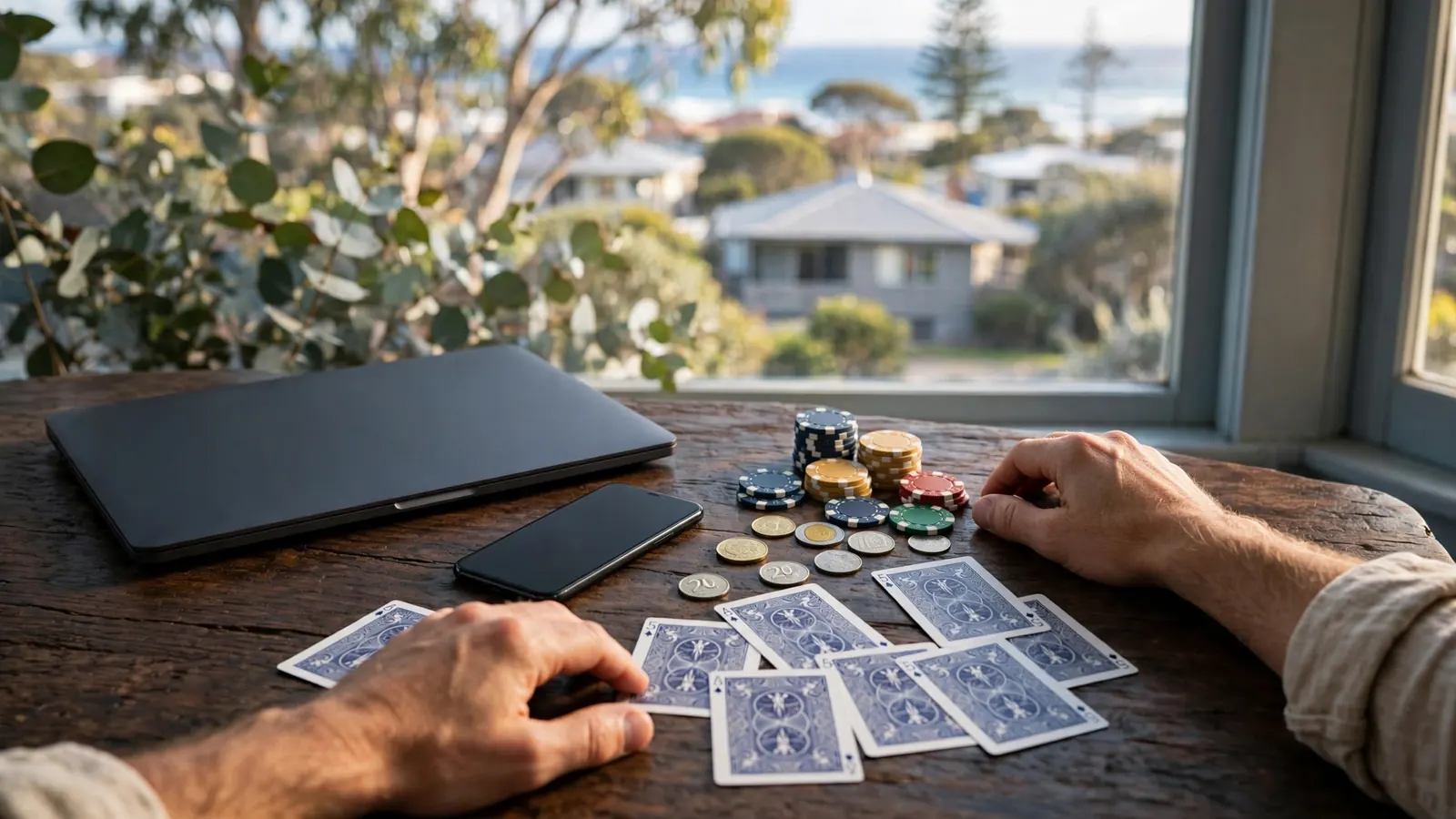
This distinction is especially relevant when a page or promotion uses a cash-oriented phrase to describe play. Such wording may sound direct, but it cannot erase the difference between a game’s own units and Bitcoin. Any claim about value needs to say which is being discussed. Otherwise, a precise-looking balance can encourage a false impression of certainty. The number is clear; its meaning may not be.
The broader setting is also material. Australian law prohibits locally licensed online casinos from offering real-money pokies to people in Australia, and the offshore operators discussed in this context do not come with Australian consumer-protection coverage. Real-money participation is restricted to adults aged eighteen or over. This is not an endorsement of offshore play; a credit display does not change the legal or consumer-protection position.
This article is affiliate material and may contain sponsored links. Commercial disclosure does not turn a game balance into cash, nor does it remove the need to distinguish the game’s credits from their changing Bitcoin comparison.
A win, then, has more than one possible description: a game may register credits, while the BTC value associated with those credits depends on the game and Bitcoin’s current price. Treating the first figure as a guaranteed cash amount skips that distinction. The display is not the whole calculation.
Casino Apps and the Question of Getting Paid
A casino app can display a balance, accept a request for payment and still leave the central question unanswered: whether the operator will approve it. The screen is an interface, not a promise. A claim that an app pays real cash describes what an operator says it can do; it does not establish that a particular account has cleared every check or that a payment will be released.
Common Payment Verification Steps
Operators may require identity and address documents or specific evidence of cryptocurrency wallet ownership, such as signing a message from the deposit address or providing a wallet screenshot.
That distinction matters in Australia, where the Interactive Gambling Act 2001 prohibits operators from providing real-money online casino games to people in the country. The offshore operators discussed in this context are not locally licensed, and Australian consumer protection laws do not apply to them. Their apps may be accessible, but access is not the same as local authorisation or a domestic remedy when a dispute arises. Real-money gambling is restricted to adults aged 18 or over; that threshold does not make an offshore service lawful.
Payment claims also tend to compress several separate stages into one reassuring phrase. An account may pass registration checks and still face further identity or account review when a payment is requested. Some operators may trigger a second stage at the first withdrawal; others may do so after cumulative deposits reach a level somewhere in the AUD 2,000–5,000 range. The threshold depends on the operator. A balance visible in an app, then, is not necessarily a balance already cleared for release.
There is a further complication when the account has used cryptocurrency. A specialist review describes possible requests to prove control of the deposit wallet: signing a message with the address used to send funds, or supplying a wallet screenshot that shows the sending transaction. These requests are not simply another password prompt. They connect the account, the payment history and the person claiming the funds, and they can add an operator-controlled step before a payout decision.
That process explains why “casino apps that pay real cash” is an imprecise description. A game result, an account balance and an approved payment are different events. The app can present the first two neatly; the last depends on checks and decisions made beyond the game screen. A polished design cannot settle a verification question.

This is especially relevant to descriptions of online casino games that pay cash. The wording can make the outcome sound automatic, as if a win travels directly from the game into a bankable sum. In practice, the operator’s account procedures intervene. A first withdrawal may be the point at which identity documents are requested, while crypto use may bring a separate request for evidence of wallet ownership. Those requirements can vary between operators, so one app’s process cannot be assumed to describe another’s.
If a payment claim appears in an app advertisement or review, its limits deserve equal attention. It may describe a feature or an operator’s stated process, not an independently enforceable obligation. This page is affiliate material and may contain sponsored links; that commercial relationship does not verify a payment claim or provide protection against an offshore operator.
The language of payment is often more definite than the process behind it. “Paid” can mean displayed, requested, reviewed or actually received—four states that an interface has every incentive to make look like one. In this market, the distinction is not cosmetic.
Deposits, No-Deposit Offers and Bonus Disputes
A Bitcoin deposit begins with an address, not a bank-style account number. The casino provides a receiving address; the player copies it and sends Bitcoin from a personal wallet. The transfer is then expected to appear in the casino account, but the steps are simple only on the screen. An address copied incorrectly can send funds elsewhere, while an address reused from an earlier payment may complicate matching a transfer to an account.
- Copy receiving addresses carefully
- Keep records of wallet transfers
- Check contribution tables for bonuses
- Reuse addresses from earlier payments
- Treat no-deposit balances as freely withdrawable
- Ignore maximum-bet restrictions during bonus play
A deposit may also go uncredited if less Bitcoin arrives than the operator expects, or if its system has not detected the payment yet. Those causes are different, though an account balance can make them look alike. The transfer record in the sending wallet can help establish what was sent and where; it does not, by itself, resolve an operator’s accounting decision. No further payment should be treated as a remedy for an unrecognised one.
The word “no-deposit” carries its own small trap. It describes an offer presented without an initial deposit, not a promise that any resulting balance is freely withdrawable or that a win is assured. In a market where Australian law prohibits operators from offering real-money online casino games to people in Australia, such wording should not be read as an invitation or endorsement. This page is affiliate material and may include sponsored links; that disclosure does not make an unlawful service lawful.
Where a bonus is attached to play, its conditions can turn on wagering contributions: how much activity in each game counts towards a requirement. Table games and pokies may be treated differently. The stated schedule can assign no contribution to table games and full contribution to pokies, while some high-return pokies may count only partially. If the terms are vague about which games qualify or how their contributions are calculated, a player and operator can arrive at different accounts of whether the condition has been met.
That disagreement is not a technical footnote. It determines whether bonus-related play is recognised under the offer’s rules. A headline amount says little about that calculation; the contribution table and its definitions do the less glamorous work. If the table is unclear, the apparent value of an offer is difficult to judge.
Maximum-bet restrictions create a separate dispute. An operator may void bonus play for exceeding the stated limit, even when the balance shows a win. The important distinction is between a game result and a result accepted under bonus conditions. A displayed win does not settle whether the terms were followed, and a vague or hard-to-find limit leaves room for a dispute after the fact.
Deposits and bonus terms therefore belong to different parts of the same transaction: one concerns whether Bitcoin reached and was credited to an account; the other concerns how play is counted and whether it remains eligible. Neither a no-deposit label nor a visible balance settles those questions. In Australia, real-money online casino services remain prohibited for operators serving people located in the country. The wording of an offer cannot alter that boundary.
Real Money Online: What Bitcoin Changes—and What It Does Not
Bitcoin changes the route money takes, not the nature of a wager. In a conventional payment, a bank or card provider sits between the account holder and the merchant. A Bitcoin transfer instead moves value across a blockchain network. That record is difficult to alter after confirmation, giving the transfer a strong technical security property. It does not, however, make every part of an online casino transaction safe: an operator can still delay or dispute a payment, and a transfer sent to the wrong address is generally unrecoverable.
The privacy difference is real but limited. A specialist review describes Bitcoin as offering more anonymity than traditional payment methods. A wallet address does not display a player’s name in the way a bank transfer may, but blockchain transactions are public records, and an operator may still request identity or wallet evidence. Pseudonymous is not invisible.
Provides a record that is difficult to alter after confirmation, offering strong technical security for transfers.
Offers more anonymity than traditional methods as wallet addresses do not display the player’s name.
Generally characterised as lower than credit card fees, though network costs can change over time.
Fees are another point of comparison. The same kind of specialist review characterises Bitcoin transaction costs as lower than those attached to credit cards and other conventional payment options. That is a comparison, not a fixed price: network fees can change, and the final cost depends on the transfer and the services involved. The blockchain is not a fee-free corridor.
For people interested in mobile pokies played for real money, a Bitcoin balance can make the payment method look like the whole story. It is only one part. The amount displayed inside a game is expressed in that game’s own credits; it does not automatically represent a stable amount of Bitcoin or ordinary cash. A specialist review notes that the relationship depends on the particular game and the current Bitcoin price. A win shown on a screen therefore needs interpretation before it can be understood as money.
Bitcoin also does not turn an offshore casino into a locally authorised service. In Australia, online casino-style games offered for real money to people in the country are prohibited, and Australian consumer protection laws do not apply to the offshore operators discussed. This page is affiliate material and may include sponsored links; that disclosure does not amount to an endorsement.
The payment method can alter privacy, transaction security and fees. It cannot settle the meaning of a game balance, guarantee that an operator will process a payment, or change the legal status of the service. Digital money, familiar uncertainties.
Free Spins, Real Winnings and the Limits of the Claim
“Win real cash” sounds like a single promise, but it can describe two quite different things. In online pokies, free play and real-money play are separate modes. A result in one does not automatically carry over to the other.
Free spins or a free-play screen can let someone see how a game behaves without staking money. A displayed win in that setting is part of the play experience; it is not, by itself, evidence of a cash payout. The distinction matters because promotional wording can place “free” and “real winnings” close together, leaving the conditions to do the work that the headline avoids.
Real-money play is a different mode: money is wagered, and a win may be represented as a monetary balance. That still does not make every claim of a “real cash payout” a guarantee. The phrase describes what is being claimed, not proof that a particular result is withdrawable or that a free-play result can be converted into cash.
So “play for free and win real cash” needs careful reading. It may blur a free demonstration with a separate real-money offer, or imply that a free result has cash value when it does not. The essential question is which mode produced the result. Free play is not real-money wagering; a win shown there should not be treated as a cash win.
That is the dividing line. Plain enough.
Claims about free slots that promise cash without a deposit deserve the same distinction: free play alone does not establish that cash can be won or paid out. Where real-money play is involved, it is no longer simply free play. The language may combine both ideas, but the modes remain separate.
Mode Identification
The critical distinction in online pokies is whether a result was produced in free-play mode or real-money wagering mode.
This matters in Australia, where a page discussing real-cash play should not be mistaken for an invitation or endorsement. It is affiliate material and may contain sponsored links. A phrase such as “real cash-paying pokies” is a claim to assess, not a finding in itself. The wording can be generous; the meaning depends on whether the play is free or involves a real-money wager.
Bitcoin Withdrawals: Addresses, Fees and Waiting
A Bitcoin withdrawal has two distinct gates: the operator’s approval and the network transaction. The request begins when a player copies a personal wallet address into the casino’s withdrawal form. That address is not a minor clerical detail; blockchain transfers sent to the wrong address are generally irreversible and unrecoverable.
A specialist review reports that most Bitcoin withdrawal transactions are completed within an hour. That describes the transaction, not the time from clicking a request to receiving funds. Before anything reaches the blockchain, an operator may still have to approve the request or process it in a queue. The distinction is plain enough. The clock has two hands.
Once a transfer is broadcast, the Bitcoin network processes it independently of the casino. A miner’s fee may be deducted or charged as part of the transfer; the amount changes over time. A specialist review characterises such fees as minuscule, but that description is not a fixed price or a promise about every transaction.
A pending request can therefore mean different things: the operator has not released it, or the network has not completed its work. Repeated requests may muddy the record rather than speed either stage. A stuck withdrawal is not a reason to send more money to unlock it. That demand is a warning sign, not a payment step.
Bitcoin and Ethereum transfers to incorrect addresses are generally unrecoverable. Australian consumer protection laws do not apply to offshore operators, so the practical remedies available may be limited. The Interactive Gambling Act prohibits operators from providing real-money online casino games to people in Australia. Real-money gambling is for adults aged eighteen or over, but age does not alter that legal boundary.

This is affiliate material and may contain sponsored links; that disclosure does not make offshore gambling lawful or endorsed.
When a Win Becomes a Verification or Security Review
A large balance does not settle a dispute by itself. An offshore operator may pause a payout for a security review after a significant win, particularly when the account is new or the withdrawal is the first of that size. A review can be legitimate; it can also become a way to delay payment. The distinction is hard to establish from the operator’s messages alone.
Verification may unfold in stages: registration checks first, identity and address documents later, and then evidence connecting a crypto wallet to the account. A specialist review describes possible crypto checks such as signing a message from the deposit address or supplying a wallet screenshot that shows the sending transaction. These are operator-specific requests, not a uniform procedure. Any request should be kept in writing, along with copies of submitted documents and the account’s transaction history.
A request for evidence is not proof of wrongdoing. Nor does the word “security” make an unexplained delay reasonable. If explanations shift, records matter: dates, messages, wallet transactions and screenshots can show what was requested and when. Complaints may be raised with the operator, but recovery options are limited when the business is offshore.
The legal setting is consequential. Australian consumer protection laws do not apply to the offshore operators discussed, and Australian law prohibits locally licensed online casinos from providing real-money pokies to residents. Real-money gambling is for adults aged 18 or over. This material is affiliate content and may include sponsored links; that disclosure does not endorse an operator or change the legal position.
A separate danger begins with the address itself. Bitcoin and Ethereum transfers sent to an incorrect address are generally irreversible and unrecoverable. If a withdrawal is stuck, sending more money to “unlock” it only deepens the loss. Stop there.
Can Australians use Bitcoin at online casinos for entertainment?
Australians can play free games, but operators must not provide real-money online casino games to people located in Australia. Using Bitcoin does not change that legal boundary.
Are Bitcoin casinos legit?
Some operators hold offshore licences, mainly from Curacao eGaming or the Anjouan Gaming Authority, but those licences do not authorise real-money casino services in Australia. Australian consumer protection laws do not apply to the offshore operators discussed.
Is verification required?
Stage-two verification may be requested at the first withdrawal or when cumulative deposits reach AUD 2,000–5,000, depending on the operator. Crypto checks may include signing a message from the deposit address or providing a screenshot of the wallet transaction.
Published by the Big Candy Casino team.