Live Baccarat Online in Australia: What to Know
 Available in AU
The guide separates local licensing from offshore access and explains live-table formats, betting rules, odds and currency costs.

Table of Contents
- Baccarat Online in Australia: A Market Outside the Local Licence System
- What “Best” Can Mean When No Operators Can Be Named
- The Dealer, the Studio and the Stream
- Live Tables and RNG Games Are Not the Same Game Experience
- The Hand, the Bets and the Arithmetic of Nine
- A Lobby Is a Schedule, Not Just a Row of Tables
- Odds, Bonuses and the Cost of Currency Conversion
- Reading the Scoreboard at the Pace of the Table
- Mobile Access, Trial Seats and the Reality of Live Play
- No Commission Baccarat: A Different Price for the Banker Bet
Baccarat Online in Australia: A Market Outside the Local Licence System
Australia’s online casino market is defined less by a domestic catalogue than by its absence. There are no locally licensed online casinos officially operating in the country. The distinction matters: a baccarat table shown on a website is not thereby part of an Australian-licensed gambling system, and a platform’s willingness to accept Australian users does not make its service locally authorised.
The governing boundary is set by the Interactive Gambling Act 2001. It does not permit Australian-licensed operators to provide online casino games, including baccarat, to people in Australia. The law is directed at the supply of the service, not at creating a domestic licence category for online casinos. In this respect, the familiar language of “choosing a licensed online casino” does not describe a local option. There is no such class of operator for online casino play in Australia.
That is a consequential difference from markets where online casino businesses may obtain a national licence and operate under local oversight. Here, a company’s registration or gambling licence elsewhere does not turn its online baccarat service into an Australian-licensed one. A foreign credential belongs to another jurisdiction and cannot be treated as a substitute for local authorisation. The legal geography is plain, even when a website’s branding is designed to make distance feel immaterial.
The state’s approach reflects a line drawn around the provision of interactive gambling services. Online casino games are not simply another product offered under the same local framework as permitted forms of wagering. The law places their supply to people physically in Australia outside the authorised system. That leaves no locally regulated online casino sector whose operators can be compared as domestic providers, whatever language a site uses about its own status.
At the same time, the legal boundary has not erased the activity from ordinary digital life. Australians do play baccarat online through international platforms that accept users from the country. That fact describes behaviour, not approval. It should not be mistaken for evidence that those platforms are locally licensed, endorsed, or protected by Australian casino regulation. A screen can make a service look close at hand; the rules governing it remain elsewhere.

Nor does the phrase “international platform” settle every question about access. Australian authorities actively block and enforce restrictions against offshore online casino services. Availability can therefore be contested or disrupted, rather than understood as a stable local market. The existence of websites, or reports of people using them, is not proof that the service is lawful to provide in Australia or that access will remain uninterrupted. The internet is not a jurisdiction, however often it is treated as one.
This is the setting in which searches for live baccarat online in Australia take place. The words describe a desired format, but they do not point to a domestic licensing system behind it. “Live” may suggest the familiar social surface of a casino table; “online” suggests a borderless room. Neither word changes the legal status of the service being supplied. The important distinction is not between one online baccarat casino and another, but between locally authorised gambling and casino services that sit outside the local system.
That distinction also shapes what can responsibly be said about the market. Naming offshore businesses, ranking them, or presenting their availability as an invitation would blur the line between description and promotion. A neutral account can note that international platforms have served Australian users, while also making clear that the law does not authorise online casino operators to provide these games to people in Australia. Familiarity is not a licence. Use is not endorsement.
Baccarat’s online presence therefore belongs to a regulatory tension: a recurring activity, carried through international services, against a domestic framework that bars operators from supplying online casino games locally. The gap is not a technicality. It is the defining feature of the Australian context, and the reason that online casino language should not be read as evidence of a lawful domestic offer.
18+ only. Gambling can cause financial harm. Big Candy Casino is not liable for gambling losses.
What “Best” Can Mean When No Operators Can Be Named
Choosing a live baccarat casino online in Australia involves checking the details that matter to you before signing up. This list gives a brief, fact-based snapshot of each operator using the information available.
Payout speed: crypto under 1 hour, PayID 1-3 business days · Min. deposit: A$20 (A$30 to qualify for the bonus) Ricky Casino lists crypto payouts in under an hour and PayID payouts in 1–3 business days. The minimum deposit is A$20, or A$30 to qualify for the bonus.
License: Curacao Gaming Control Board OGL/2023/176/0095 (Hollycorn N.V.) Neospin lists a Curacao Gaming Control Board licence, OGL/2023/176/0095, held by Hollycorn N.V.
License: Curacao · Payout speed: crypto 30-60 minutes, fiat 1-5 days · Min. deposit: A$10 Wild Tokyo lists a Curacao licence, with crypto payouts in 30–60 minutes and fiat payouts in 1–5 days. Its minimum deposit is A$10.
License: Curacao Gaming Control Board OGL/2023/174/0082 (Dama N.V.) SpinsUp lists a Curacao Gaming Control Board licence, OGL/2023/174/0082, held by Dama N.V.
License: Tobique Gaming Commission · Payout speed: crypto ~10-15 minutes, fiat 1-5 days · Min. deposit: A$30 SkyCrown lists a Tobique Gaming Commission licence. Its stated payout times are around 10–15 minutes for crypto and 1–5 days for fiat; the minimum deposit is A$30.
License: Curacao – Antillephone N.V. (Versus Odds B.V.) · Min. deposit: EUR 20 Thor Casino lists a Curacao licence through Antillephone N.V. (Versus Odds B.V.). Its minimum deposit is EUR 20.
License: Curacao Gaming Authority (Jumpman Gaming Ltd) DragonSlots Casino lists a Curacao Gaming Authority licence held by Jumpman Gaming Ltd.
License: Curacao eGaming (Roby Games Ltd) Roby Casino lists a Curacao eGaming licence held by Roby Games Ltd.
License: Curacao OGL/2024/1335/0780 · Min. deposit: EUR 20 Vegaz Casino lists a Curacao OGL licence, OGL/2024/1335/0780. Its minimum deposit is EUR 20.
License: Curacao Gaming Control Board (TechSolutions Group N.V.) Bizzo Casino lists a Curacao Gaming Control Board licence held by TechSolutions Group N.V.
“Best” sounds like a verdict, but in a comparison of live baccarat tables it is more useful as a question about fit. A table can have a high ceiling and still be unsuitable for a particular bankroll; a modest limit may be more relevant than a prestigious label. Without naming or ranking operators, the comparison has to rest on what can be examined at the table level: the stated limits, the terms attached to them and whether those terms are clear before play begins.
The distinction matters because casino language often turns scale into status. A VIP label, for instance, says something about how a table is presented, not by itself about whether its conditions are favourable. A specialist review has reported VIP baccarat limits reaching A$20,000 per bet at some casinos. That is a reported ceiling, not a general market standard or a reason to treat a high-limit table as a better one. For most comparisons, the useful question is more prosaic: does the minimum and maximum suit the scale of play being considered, and are both plainly stated?
Table Suitability
- Check if the minimum bet fits the bankroll
- Verify if the maximum bet meets the required ceiling
- Ensure table limits are plainly stated
- Confirm that terms governing the table are legible and understandable
A limit is not a decorative number beside a table name. It defines the permitted range of a bet, and that range shapes who can take part. A low maximum may make a table irrelevant to someone seeking higher stakes; a high minimum may put it out of reach for someone else. Neither is an intrinsic mark of quality. “Best” can only be relative to a stated purpose, and a comparison that leaves the purpose unstated quietly substitutes prestige for analysis.
Clarity is another measure. Table information is useful when it makes the conditions legible rather than asking a player to infer them from a badge or a promotional description. Any stated limits should be easy to locate, and the terms governing the table should be understandable before a decision is made. If the relevant conditions are scattered, ambiguous or difficult to distinguish from marketing language, the comparison has already found something important: not necessarily a poor table, but a poor basis for confidence.
That is a modest standard, though not a trivial one. Gambling products are designed to make participation feel immediate; comparison requires a pause. The pause belongs before any money is committed, when labels can be separated from terms and the table’s actual boundaries can be read without the atmosphere doing the work. A polished interface cannot make unclear conditions clearer.
The same restraint applies to claims about exclusivity. “Private”, “premium” or “VIP” may describe access or presentation, but those words do not establish what a table costs to enter, what its maximum permits, or whether its terms suit a particular person. The relevant information is the information behind the label. Where that information is absent, the label remains a label.
This approach also limits what a comparison can honestly conclude. A table can be described as having clearly stated limits; it cannot be declared universally best on that basis. A high ceiling may matter to one kind of player and mean nothing to another. A lower entry point may widen access without making the table safer or more advantageous. Suitability is not a trophy, and there is no single scale on which every table can be placed.
A larger permitted stake at a VIP table does not improve the underlying proposition or turn the table into a sound financial choice.
There is a social history in the word “VIP”: the old habit of treating wealth as evidence of discernment. Casino design has ample reason to encourage that association. But a larger permitted stake is simply a larger permitted stake. It does not improve the underlying proposition, and it does not turn a table into a sound financial choice. The language is grander than the fact.
So a careful account of the best baccarat table does not begin with a crown or a ranking. It begins with a narrow set of questions: what limits are stated, how clearly are the terms presented, and do those conditions correspond to the scale of play in view? Those questions cannot settle every preference, but they can expose the difference between a usable description and an unsupported boast.
This is descriptive information, not an invitation to gamble. Gambling can cause financial harm, and Big Candy Casino is not liable for losses. Live dealer gambling is for adults aged 18 and over.
The Dealer, the Studio and the Stream
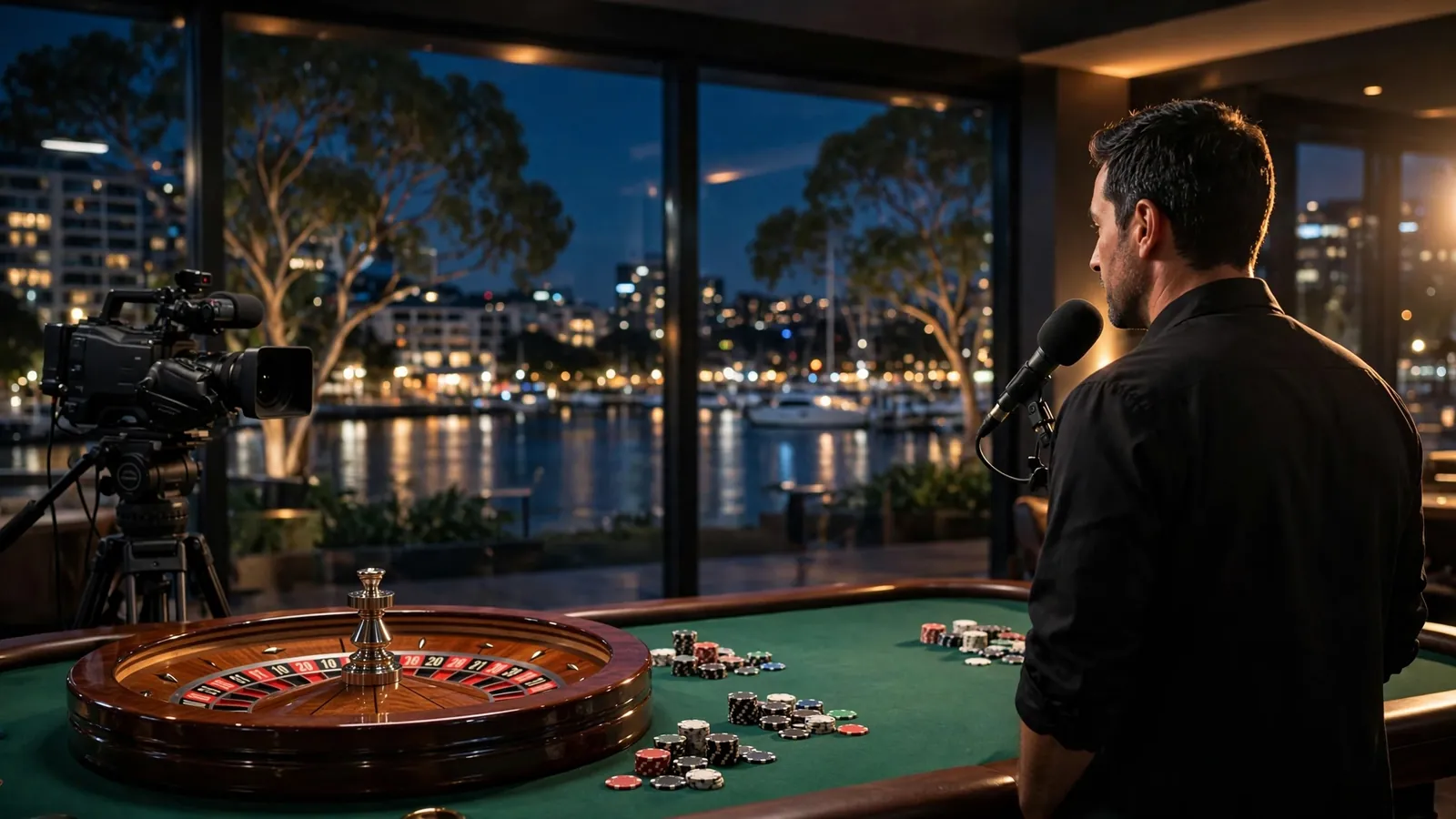
A live dealer baccarat table is a small performance staged for a camera. The dealer handles physical cards in a studio; the table, dealer and dealt cards are streamed to a virtual table on screen. The player is not gathered around the felt with the others. The camera supplies the view, while the interface carries the parts of the encounter that can be made digital.
That distinction gives the format its particular atmosphere. A card has weight and a place in the dealer’s hands before it becomes an image on a screen. The studio supplies the room, lighting and table; the stream turns that room into a shared viewing space for people elsewhere. It is a carefully arranged scene, though not quite theatre: the dealer is there to conduct the game, not to perform a character.
The dealer is the human centre of the broadcast. A professional host presents the table and handles the cards in full view of the camera. The stream lets players follow the action as it happens, rather than receiving only a result after the fact. The arrangement makes visible the gestures that an entirely digital interface would omit: the dealer’s hands, the cards being moved, the pauses between actions. Presence is not the same as proximity, but the format depends on making the distance feel organised.
A virtual table is therefore more than a graphic laid over a game. It is the point at which the studio’s physical activity meets the player’s screen. The image and interface work together: one shows the dealer and cards, the other provides the space in which participation is managed. That division is easy to overlook because it is designed to look seamless. Behind the apparent simplicity sits a production with a real room at one end and a remote audience at the other.
Some tables also provide chat, allowing players to send messages to the dealer or to one another. A specialist review describes this as an available feature, rather than a certainty at every table. Where it is present, chat lends the broadcast a social edge: the dealer is no longer only a figure on screen, and the other players are no longer merely anonymous positions around a virtual layout. Still, interaction remains bounded by the format. The dealer is working within a broadcast, and the conversation takes place through the tools the table provides.
Social Interaction Features
Some tables provide chat, allowing players to send messages to the dealer or to one another. This lends the broadcast a social edge, though interaction remains bounded by the format of the broadcast.
The studio is part of the game’s presentation, but it does not turn remote play into a visit to a casino. The player sees a camera’s chosen angle, not the whole room; the social setting is mediated, not shared in the ordinary sense. That small difference matters. Live play borrows the visible customs of a table—dealer, cards, attentive pauses—while relocating them to screens in separate homes.
For Australian readers, this description is about the format, not an invitation to use a real-money casino service. The legal position is that operators cannot provide online casino games to people physically in Australia under the Interactive Gambling Act 2001. The website is not liable for gambling losses, and gambling can cause financial harm. 18+ only. If gambling is causing harm, support is available through appropriate Australian services.
Live Tables and RNG Games Are Not the Same Game Experience
The distinction between live dealer baccarat and RNG baccarat is not a matter of screen design. It lies in what produces each result. In one format, physical cards are dealt at a table; in the other, algorithm-based software determines the outcome. The familiar table layout can make the two look like versions of the same online casino game. Their resemblance ends at the interface.
Live dealer baccarat keeps the cards in the material world. A hand is made from cards handled at a table, while a camera carries the event to the screen. The dealer and the cards belong to a visible sequence: a card is dealt, it appears, and the round proceeds. The stream gives the game a human and physical presence, even though the person watching is not seated in the studio.
RNG baccarat removes that physical sequence. There is no deck being dealt on screen to create each result. Software uses an algorithm to determine outcomes, and the interface presents them as a playable baccarat game. It may retain familiar imagery and the outline of a table, but those elements do not turn the software process into a card deal. The appearance is representational; the mechanism is computational.
This is a useful distinction because people often judge a casino game by what it looks like. A digital table can borrow the green baize, the card positions and the ceremony of a live room. Yet an image of a card is not a card, any more than a streamed table is simply a graphic. In live play, the camera records a physical event. In RNG play, the screen displays an outcome determined by software.
Neither description makes one format a substitute for the other. Someone drawn to the visible handling of cards may find the software-based version too abstract. Someone who values a direct, software-run presentation may see the live table as an unnecessary layer of ceremony. These are different expectations of what a baccarat game should feel like, rather than competing claims about which interface is more authentic.
Physical cards are dealt at a table in a studio and streamed via camera to a virtual interface.
Algorithm-based software determines the outcome, presenting it through a representational digital interface.
The contrast also changes the meaning of “watching.” In a live game, watching means following an event as it happens: the movement of cards and the dealer’s actions are part of the experience. In RNG baccarat, watching means reading a display of results generated by an algorithm. The player may see the same broad symbols and table arrangement, but the source behind them is different. One is a filmed procedure; the other is software output.
Online baccarat games can therefore share a name without sharing a method. The distinction matters more than decorative details: a polished digital table does not establish that real cards are involved, and a live stream is not merely a software animation. The format should be understood by how its outcomes are produced, not by how convincingly its screen resembles a casino table.
That is the dividing line. Not the felt.
This description is for readers aged 18 and over. Gambling can cause financial harm; it is not a source of income, and Big Candy Casino is not liable for losses. If gambling is causing harm, seek support.
The Hand, the Bets and the Arithmetic of Nine
A baccarat table presents three familiar choices: Player, Banker and Tie. These names refer to the outcomes being backed, not to roles a participant takes on. The two hands are dealt, their totals are compared, and the winning side is the one nearer to nine. A Tie bet backs equal totals. The arrangement is spare; the arithmetic does the work.
The table layout makes that structure visible. Betting areas for Player, Banker and Tie sit apart, so each wager has a clear destination before the cards are dealt. In live dealer baccarat, the same choices appear on screen around the virtual table. A bet is placed on an outcome, then the hand resolves according to the cards. There is no need to make decisions about how to build a hand: baccarat’s dealing rules govern what happens next.
Card values are designed to bring totals back to a single digit. Number cards count at face value; picture cards count as zero. When a hand’s sum exceeds ten, the digit on the left is discarded. So a total of twelve is read as two, not twelve. The aim is not to assemble the largest possible total, but to finish as close to nine as the rules allow.
That small distinction changes the feel of the game. A hand that looks larger in ordinary arithmetic may be weaker in baccarat once the left-hand digit is dropped. The cards are added, then the total is reduced to its units digit. Nine is the high point; zero is a valid total too.
The initial deal does not always settle the hand. If a hand’s total is below five, another card is dealt. The rule is mechanical rather than a matter of choice: players have backed Player, Banker or Tie, but they do not decide whether a hand draws. That separation between wagering and dealing is part of the game’s distinctive economy. The visible decision is made before the action; after that, the table follows its procedure.
For someone learning how to play baccarat, the useful sequence is therefore simple: choose an outcome, follow the two totals, and compare their distance from nine. The Player and Banker labels can sound like invitations to identify with one side, but they are merely names on the felt. Neither side belongs to the person placing the bet.
Baccarat Hand Process
Choose an outcome by betting on Player, Banker, or Tie.
Follow the two totals as cards are dealt according to mechanical rules.
Compare the distance of both totals from nine to determine the winner.
The simplicity has its own kind of ceremony. Cards are revealed in order; totals are called; the result becomes legible through a rule that can be followed without interpreting a complicated strategy. That does not make every wager equivalent, nor does it turn a run of results into a forecast. It only explains the hand.
Nine, then reset.
A Lobby Is a Schedule, Not Just a Row of Tables
A baccarat lobby can look like a catalogue: table names, limits, a dealer image and a button to join. But its practical shape is temporal. A live table may not be available whenever someone happens to open the page; schedules can impose time restrictions. A specialist review advises checking the schedule for the particular table rather than assuming that a listing means continuous play.
That distinction matters because a table label tells little about whether its hours fit a planned session. A lobby may display several versions of the game while their operating times differ. The relevant detail is not the number of tiles on screen but whether the table is scheduled to run at the time in question. An attractive interface cannot extend a timetable.
There is a larger Australian context that a lobby cannot erase. The Interactive Gambling Act 2001 prohibits operators from providing real-money online casino games to people in Australia, and offshore services are subject to blocking and enforcement. A page being visible, or a table appearing in a menu, is not evidence that the service is lawful or available for Australians to use. Presentation is not permission.

The same caution applies to withdrawal terms. A weekly cap can affect access to funds even when a site’s branding suggests exclusivity or a polished service. One specialist review reported weekly withdrawal ceilings in the $5,000–$10,000 range at offshore sites; that is a report from one review, not a dependable market-wide rule. Terms can differ, and a headline figure should not be mistaken for a guarantee of payment or a complete account of the conditions.
The useful comparison, then, is not between grand labels but between the operating details stated in the terms: when a table runs and what limits apply to withdrawals. These details belong to different clocks. The table schedule governs when play is offered; the withdrawal cap governs how funds may be released. Neither is settled by a strategy claim, a VIP badge or the neatness of the lobby.
A baccarat strategy cannot alter a table’s timetable or a withdrawal condition. Nor does a familiar interface turn those conditions into safeguards. For Australians, the legal restriction on real-money online casino services remains decisive, regardless of how orderly a lobby appears.
18+ only. Gambling can cause financial harm. Big Candy Casino is not liable for gambling losses.
Odds, Bonuses and the Cost of Currency Conversion
Baccarat odds are often discussed as if every marked outcome carried a similar price. They do not. The house edge attached to the Banker bet is 1.06%, compared with 1.24% for Player. The Tie is in another category: its house edge is 14.36%. These figures describe the mathematical cost built into each bet over repeated play, not a forecast of what any particular hand will do.
Legal Restriction
Under the Interactive Gambling Act 2001, operators are prohibited from providing real-money online casino games to people physically in Australia.
That difference matters when a bonus is placed beside the game. A promotion can look substantial in its headline description while the relevant question is how much baccarat play counts towards its wagering requirement. A specialist review reports a contribution of 5–15% for live baccarat. That is a reported range, not a dependable rule for every offer: the applicable terms determine whether the game counts and how much. A low contribution can make a bonus slower to clear than its headline suggests. The arithmetic is less festive.
Currency adds a separate cost. Where a balance is held in US dollars or euros, an Australian-dollar transaction may incur a conversion margin of 2.5–4%. An AUD-denominated wallet avoids that particular margin. This does not remove other charges or make gambling less financially risky; it simply prevents the stated foreign-currency conversion cost from being part of the calculation.
Bitcoin and other digital currencies sometimes appear in discussions of casino payments, but the payment label says little about the price of a game or the terms attached to a bonus. The house edge still belongs to the bet, while any conversion between a cryptocurrency and Australian dollars introduces a separate question about value and fees. Neither a coin nor a bonus changes the underlying odds.
There is also a legal boundary that cannot be tidied away by payment choice: Australian law prohibits operators from providing real-money online casino games to people in Australia. The figures above describe baccarat mathematics and reported bonus terms; they are not an invitation to use an offshore service.
18+ only. Gambling can cause financial harm. Big Candy Casino is not liable for losses arising from gambling.

Reading the Scoreboard at the Pace of the Table
A baccarat scoreboard is a record of completed hands, not a forecast. Its rows and columns can make repetition look like a pattern with a destination; the table, however, does not acquire a memory because its results have been arranged neatly on a screen. Previous outcomes describe what has happened. They do not establish what comes next.
Pace affects how quickly that record grows. One specialist review estimates that a standard live table deals around 40–50 hands in an hour, while a Speed table exceeds 80. These are reported estimates, not a fixed schedule: the rhythm can vary with the table and the dealing process. Still, the contrast matters. A scoreboard beside a faster table can fill more quickly, making recent sequences more prominent simply because more hands have been recorded in the same stretch of time.
That is a change in tempo, not in meaning. A longer run of entries may feel more persuasive than a shorter one, especially when the display groups outcomes into streaks. Yet the visual arrangement is an account of past play, not evidence that one side is due or that a sequence will continue. Reading the board as a historical log keeps its role in proportion.
The pace also shapes the character of a session. Standard tables leave more space between recorded hands; Speed tables compress that interval. The difference can influence how much activity appears on the scoreboard, but it cannot turn the board into a guide to future results. Faster is not wiser. It is merely faster.
Scoreboard Insights
- The scoreboard is a historical log of past play, not a forecast.
- Speed tables record results faster, but the meaning of the data remains the same.
- Visual streaks of outcomes do not establish that one side is due or that a sequence will continue.
In Australia, information about casino baccarat does not alter the legal position of real-money online casino services: the Interactive Gambling Act 2001 prohibits their provision to people in the country. This discussion is informational, not an invitation to play.
18+ only. Gambling can cause financial harm. Big Candy Casino is not liable for gambling losses.
Mobile Access, Trial Seats and the Reality of Live Play
A baccarat table can fit on a phone screen; that does not make participation frictionless. Specialist reviews describe live baccarat as available on Android and iOS devices, but access depends on the particular game interface and the connection carrying its video. A small screen may compress the table’s details, while a touch interface replaces the gestures of a physical game with taps and menus. Portability changes the setting, not the underlying conditions of play.
The distinction matters because live dealer games do not always offer the familiar low-stakes rehearsal found in digital games. Specialist reviews report that trial access can be limited: a live table has a finite number of seats, and those seats are occupied by participants rather than generated for unlimited practice. A trial option, where available, therefore may not behave like a private tutorial that can be opened whenever convenient.
Scarcity is part of the format. The table is shared, and access is shaped by the people already playing and the platform’s arrangements. That makes a phone a viewing and betting device, not a guarantee of a place at the table. Mini baccarat may appear in a digital lobby, but the label alone says little about whether its live version has trial access; the relevant distinction is between a simulated practice mode and a seat in a live game.
A specialist review also reports that live dealer games are often offered only for real money. In those cases, participation requires a real-money bankroll, rather than a free balance set aside for practice. The difference is consequential: learning the interface and risking funds are not the same activity, though a lobby can place them close together.

For Australian audiences, this is descriptive information, not an invitation to use an online casino. Gambling can cause financial harm, and Big Candy Casino is not liable for losses. 18+ only. Responsible gambling means recognising when play is no longer controlled and seeking appropriate support. A screen makes a table portable. It does not make its risks portable away.
No Commission Baccarat: A Different Price for the Banker Bet
The name suggests a simpler bargain: a winning Banker bet is paid without the familiar commission. But the charge does not always vanish; in some versions, the table changes the payout for particular Banker totals instead. The difference is in settlement, not in the cards.
Under the standard arrangement, a casino deducts a 5% commission from a winning Banker wager. No Commission Baccarat removes that deduction, while the rules may reduce the return when Banker wins with a specified total. The table’s paytable is therefore part of the game, not small print to be left for later.
This matters because “no commission” describes one feature, not the whole price. A player comparing versions needs to see which Banker outcomes receive altered payouts and how those returns are displayed. The game can keep the familiar deal and still settle a winning hand differently. Same cards. Different arithmetic.
Specialist reviews describe this variant as removing the commission while changing payouts on certain Banker totals; the exact settlement terms should be read in the table rules. That qualification is essential: the label alone does not establish the return for every winning Banker hand. In casino baccarat rules, a small change in payout can be more consequential than a conspicuous change in presentation.
No Commission Baccarat is thus not simply standard baccarat with a fee crossed out. It trades a visible deduction for a condition attached to particular wins. The wording sounds cleaner than the accounting.
Can you play live dealer baccarat online?
Yes, international platforms that accept Australian players offer live dealer baccarat, streamed from a studio with a real dealer and physical cards. These services are not locally licensed in Australia.
Are there live baccarat casinos in Australia?
There are no locally licensed online casinos in Australia, but international platforms that accept Australian players offer live baccarat.
Is it possible to trial the game before playing?
Yes, trial play may be available, but it is typically limited because live-table seats are limited.
Which baccarat bet does the page describe as mathematically better in almost every variant?
The Banker bet has the lower house edge in standard live baccarat: 1.06%, compared with 1.24% for Player and 14.36% for Tie.
When can I play? Is it time restricted?
Some live baccarat schedules may impose time restrictions. Check the schedule for the table you choose.
Prepared by the Big Candy Casino editorial staff.