
Three-Reel Slots in Australia: How They Work
 Available in AU
The reels show the result, while each game’s paytable defines which symbol arrangements count as wins and what they pay.
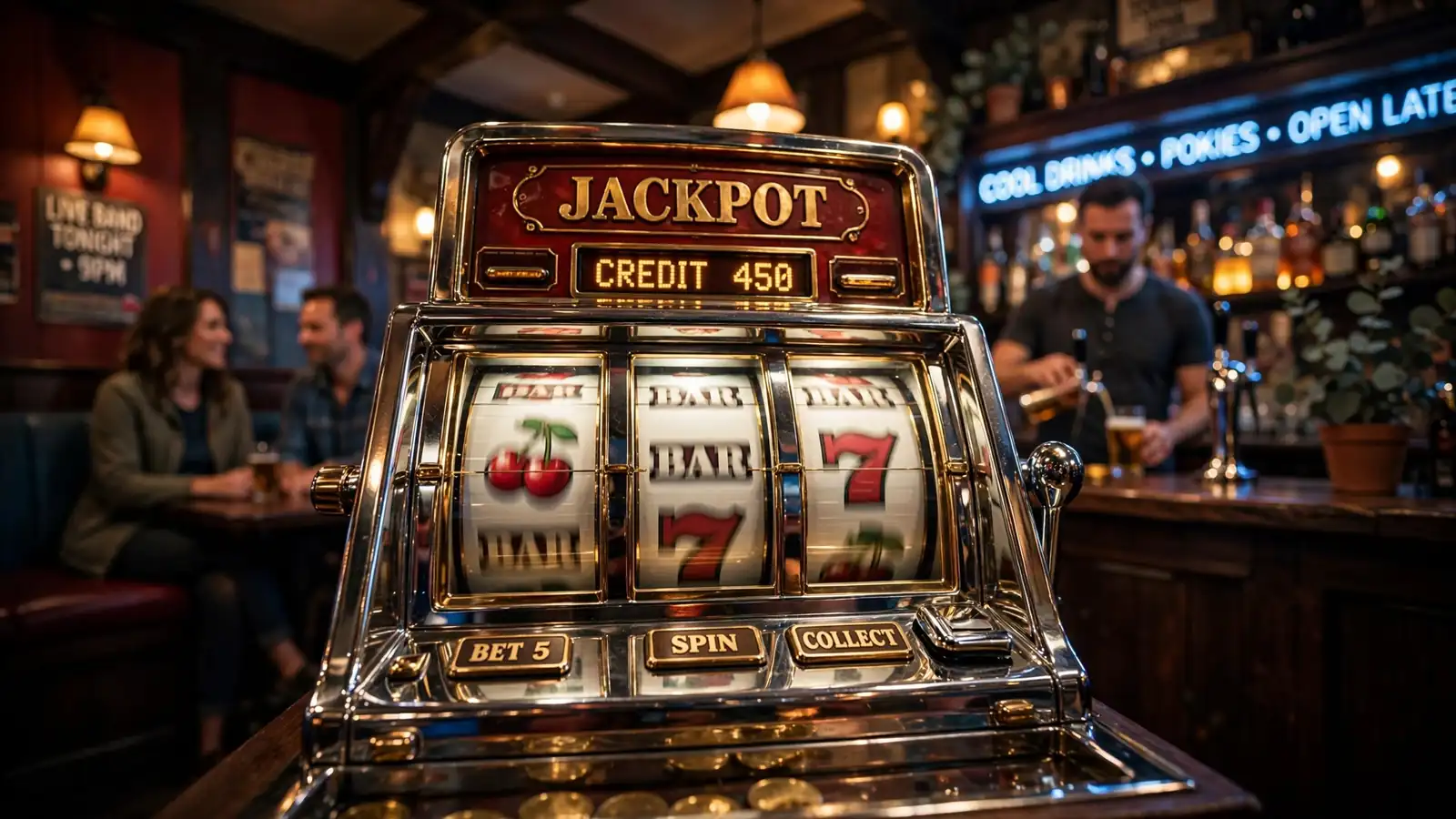
Table of Contents
- Three Reels, and the Numbers Behind Them
- Bonus Rounds in Sweet Bonanza
- Classic Slots and the Appeal of the Familiar
- Casino Games, Random Outcomes
- Free Play and the Paytable
- Downloads, Browser Play, and the RTP Build
- Playing a Spin: Chance, Not a Pattern
- Online Slots and the Australian Boundary
- Three Reels, Three-Reel Slots
Three Reels, and the Numbers Behind Them
A three-reel slot is defined by its visible layout: three reels, each carrying symbols that settle into a result when a spin ends. The arrangement is compact, but the label describes the format, not the game’s generosity or its likely outcome. A small screen can still contain a detailed paytable; a familiar-looking row of symbols can still be governed by rules that vary from one game to another.
The basic task of reading the screen is straightforward. Symbols appear across the reels, and the game’s rules explain which arrangements count as wins and what those arrangements pay. The paytable is therefore more than decoration beside the game. It sets out how the visible symbols are interpreted. Two games can both be three-reel slots while assigning different meanings to their symbols or combinations.
That distinction matters because the number of reels is a design choice, not a measure of value. Three reels do not, by themselves, tell anyone how often a winning arrangement appears, how large a result may be, or what proportion of stakes is returned over time. Nor does the label “classic” establish a particular payout rule. The format tells the eye what is on screen; the rules tell it what the screen means.
Choosing a reel slots site for Australia involves more than the games: payment details and licensing can also help you assess an operator. This overview highlights the specific information available for each option.
Payout speed: crypto under 1 hour, PayID 1-3 business days · Min. deposit: A$20 (A$30 to qualify for the bonus) Ricky Casino lists crypto payouts in under an hour and PayID payouts in 1–3 business days. The minimum deposit is A$20, or A$30 to qualify for the bonus.
License: Curacao Gaming Control Board OGL/2023/176/0095 (Hollycorn N.V.) Neospin is listed under Curacao Gaming Control Board license OGL/2023/176/0095, held by Hollycorn N.V.
License: Curacao · Payout speed: crypto 30-60 minutes, fiat 1-5 days · Min. deposit: A$10 Wild Tokyo lists a Curacao license and a minimum deposit of A$10. Its stated payout times are 30–60 minutes for crypto and 1–5 days for fiat.
License: Curacao Gaming Control Board OGL/2023/174/0082 (Dama N.V.) SpinsUp is listed under Curacao Gaming Control Board license OGL/2023/174/0082, held by Dama N.V.
License: Tobique Gaming Commission · Payout speed: crypto ~10-15 minutes, fiat 1-5 days · Min. deposit: A$30 SkyCrown lists a Tobique Gaming Commission license and a minimum deposit of A$30. Its stated payout times are around 10–15 minutes for crypto and 1–5 days for fiat.
License: Curacao – Antillephone N.V. (Versus Odds B.V.) · Min. deposit: EUR 20 Thor Casino lists a Curacao license issued through Antillephone N.V. to Versus Odds B.V. Its stated minimum deposit is EUR 20.
License: Curacao Gaming Authority (Jumpman Gaming Ltd) DragonSlots Casino is listed under the Curacao Gaming Authority, with Jumpman Gaming Ltd named as the license holder.
License: Curacao eGaming (Roby Games Ltd) Roby Casino is listed under a Curacao eGaming license, with Roby Games Ltd named as the license holder.
License: Curacao OGL/2024/1335/0780 · Min. deposit: EUR 20 Vegaz Casino lists Curacao license OGL/2024/1335/0780 and a minimum deposit of EUR 20.
License: Curacao Gaming Control Board (TechSolutions Group N.V.) Bizzo Casino is listed under a Curacao Gaming Control Board license, with TechSolutions Group N.V. named as the license holder.
RTP, or return to player, is a separate measure. It is a theoretical statistical calculation of a game’s expected performance across a vast volume of spins, often millions. It is not a promise about an individual player’s session, nor a schedule that guarantees a particular share will come back after a set number of attempts. The scale is collective and long-run. A single session is small enough to tell a very different story.
That gap between a statistical model and an evening’s results is easy to misunderstand. A percentage can look like a personal forecast, especially when it is printed neatly beside a game’s rules. It is not. RTP describes an expected pattern across extensive play, while any short stretch may produce results above or below that expectation. A figure cannot say what will happen next, or settle what has already happened.
A higher RTP theoretically indicates a better return over time than a lower RTP, when the comparison is between games on that measure. The word “theoretically” does important work. It keeps a long-run calculation from being mistaken for a guarantee or a verdict on a particular visit. For this reason, players comparing game information are often advised to look for an RTP of 96% or higher. That threshold is a comparison point, not a forecast for one person’s results.

The published figure is usually found in the game’s rules or paytable. Its placement beside symbol explanations makes sense: one describes how combinations are evaluated, while the other gives a statistical measure of expected return over extensive play. Both belong to the game’s information, but they answer different questions. The paytable explains the terms of the screen; RTP describes a long-run expectation.
A three-reel layout can make a game appear legible at a glance. The mathematics behind it is less visible, and the neatness of the display should not be confused with simplicity of outcome. Even where the symbols and rules are easy to follow, RTP remains a broad statistical measure rather than a personal balance sheet. The reels show a result; the percentage describes something much larger.
That is the useful distinction for anyone examining three-reel slots: format is what the game looks like, rules define what its arrangements mean, and RTP concerns theoretical performance over extensive play. None of those categories can stand in for the others. The modest screen does not make the statistic immediate. Long-run arithmetic stays long-run arithmetic.
Bonus Rounds in Sweet Bonanza
Sweet Bonanza’s bonus is built around scatters and free spins, rather than the familiar image of three reels stopping in a row. That distinction matters when the game is described alongside “3 reel bonus slots” or other classic-style pokies: the wording may group games together, but Sweet Bonanza’s bonus feature belongs to its own format. Its central sequence is a scatter-triggered entry into free spins, followed by tumbles in which winning symbols disappear and new ones can land.
Four or more scatter symbols typically award 10 free spins, acting as the trigger to open the bonus round.
A specialist review describes four or more scatter symbols as typically awarding 10 free spins. The scatter symbols do not need to form an ordinary line win to serve this trigger; their role is to open the bonus round. The exact rules displayed in the game remain the useful reference, since the bonus terms are part of the particular version being played. The free spins are not a separate game or a promise of a payout. They are a different phase, with a feature that can alter how a winning tumble is calculated.
That feature is the multiplier bomb. A specialist review reports that bombs can appear during free spins, with their values added together before being applied to a winning tumble. In practice, this means the bonus is not simply a set of extra spins with the base game unchanged: the bombs create a possible multiplier effect within the round. The order matters. Their values are gathered first, then applied to a winning tumble. A bomb on its own is not the same thing as a win, and the feature does not turn every free spin into a paying one.
The tumble mechanic gives the sequence its particular rhythm. When a combination wins, those symbols clear and replacements fall into the spaces; another win may follow within the same spin. In the bonus, multiplier bombs interact with winning tumbles rather than guaranteeing that a tumble will occur. The result can look more eventful than a simple reel stop, but activity on screen is not evidence that a return is due. The feature explains how a bonus can develop, not what any one round will deliver.

A specialist review lists Sweet Bonanza’s RTP as 96.51%, while noting that versions may show a different figure. That number should therefore be treated as a reported configuration, not a universal setting for every copy of the game. RTP is a long-run theoretical measure, not a forecast for a free-spin round or an individual session. The displayed figure can vary with the version supplied, so the game’s own information is more relevant than a general description of the title.
The same care applies to the stake range. A specialist review gives a typical range of A$0.20 to A$100 per spin, with the upper end varying by operator. It is a reported range, not a promise that every version offers those exact choices. The stake selected affects the amount attached to a spin; it does not make the scatter trigger more certain or change the basic description of the bonus. The numbers describe possible settings, not a measure of how often the feature appears.
Free versions can make the bonus sequence easier to inspect without placing a stake, but the experience should not be confused with a real-money round. A free-play mode can show how scatters, tumbles and bombs are presented; it cannot establish that a particular run predicts what happens elsewhere. Nor does the word “free” mean that the game’s displayed settings are identical across every version. The informational value lies in seeing the rules and feature sequence, not in treating a sample as a forecast.
The appeal of this design is partly theatrical: a scatter opens a distinct round, symbols vanish and refill the screen, and bombs collect their values before a winning tumble is evaluated. It gives the bonus a visible beginning and a sequence of events to follow. That is a different pleasure from the spare familiarity associated with three-reel pokies, where the attraction often lies in compact symbols and an instantly readable layout. Sweet Bonanza is better understood through its own bonus language than filed under a format merely because both are called slots.
- Use scatters to enter free spins
- Collect multiplier bombs to increase winning tumbles
- Treat the bonus as a guaranteed payout
- Assume the bonus is a separate game from the base
The important distinction is between a feature’s rules and its promise. The scatters define a route into free spins; the bombs explain one way a winning tumble may be multiplied. Neither mechanism says when a bonus will arrive or what it will return. An elaborate round is still a round of chance. The machinery is visible. Its outcome is not.
Classic Slots and the Appeal of the Familiar
The classic style rests on recognition. Its presentation is compact, and its visual language draws on an older image of the slot machine: a small, self-contained game rather than an elaborate digital world. That familiarity can be part of the appeal. The format asks less of the eye and offers a clear boundary around the activity.
Online, that impression can survive even when the setting changes. A classic three-reel game on a screen is still a digital product, not a mechanical cabinet transplanted intact. The familiar look is a design choice; it does not tell anyone how the game is built underneath, or what a particular spin will do. Appearance and operation belong to different questions.
That distinction matters because “classic” is often used as if it were a technical promise. It is better understood as a style label. It describes a recognisable, restrained presentation, not a guarantee about the rules, the return, or the odds. Those details belong to each game’s own information, not to the aesthetic category.
The appeal is partly cultural. Slot machines have long occupied a place in popular imagery as small rituals of chance: a brief pause, a button or lever, and an outcome that arrives without requiring a long account of its own. Digital design can preserve that sense of simplicity. It can also make the old form feel curated, as though the past were being presented in a neat frame. Nostalgia, tidied for a screen.
Yet familiarity is not evidence of predictability. A classic design may look simpler than a more decorated game, but its appearance does not make outcomes easier to read. Each spin remains a separate random event, generated through a Random Number Generator; the visual style does not turn a previous result into a clue about the next one. The machine may look like a familiar object. It does not remember a run of results.

For the same reason, the label says little about the experience beyond its presentation. Two games described as classic can differ in their rules and other details. A title’s name or visual mood cannot fill in those particulars. In that sense, the category is useful but limited: it helps describe how a game presents itself, not everything a player needs to know about it.
The concise format also has a social history. The original appeal of the slot machine was not a sprawling narrative or a complicated world to explore, but an easily understood encounter with chance. Online design can borrow that economy of attention. The result may feel less demanding than a game built around elaborate scenes, but “simple” here refers to presentation, not to certainty or control.
Names such as Sweet Bonanza and Blood Suckers belong to individual products, not to a definition of the classic style. A title should not be assigned classic features merely because it appears beside one, nor should the category be treated as a list of guaranteed qualities. The distinction is modest: a familiar format can be recognised at a glance, while its actual rules still have to be read on their own terms.
That is the limit of nostalgia. It can make a digital game feel legible, but it cannot make chance legible.
Casino Games, Random Outcomes
The visible reels invite the eye to search for order: a symbol appears, another follows, and the arrangement seems to carry a hint about what might come next. That impression belongs to the display, not to a dependable sequence. Online pokies use a Random Number Generator (RNG), and each spin is a separate random event, independent of the spins before and after it.
An RNG is the mechanism behind that separation. It produces the result for a spin without treating an earlier result as an instruction for the next one. A run of similar outcomes does not establish a pattern that the following spin must continue or correct. The machine has no memory in the human sense; a sequence that looks striking to a person does not, by itself, change the next result.

This can be easy to forget when outcomes are presented in a familiar physical form. A three-reel slot machine, whether styled as a 3-reel classic slot or as a more contemporary game, places symbols in a compact visual arrangement. The player sees reels stop and reads the result across them. Yet that presentation should not be mistaken for evidence that the reels are taking turns in a predictable cycle. The relevant point is the independence of each spin, not the apparent rhythm of the animation.
A 3-reel casino game may look simpler than a screen crowded with effects, but simplicity of presentation does not make an outcome easier to forecast. Nor does a more elaborate display make a result less random. The symbols, colours and motion are ways of showing a game result; they are not a record of what the next result is due to be. Familiarity can make the visual story legible. It cannot make chance disclose its next move.
That distinction also matters when people describe a machine as “hot” or “cold”. Such language gives a run of outcomes a character, as though the game were moving through a mood or settling an account. It is an understandable human habit: people make narratives from repeated events, especially when money and anticipation are involved. But one spin does not put the next spin into debt, and a string of losses does not compel a win to arrive. Equally, a win does not make a further win more likely simply because the previous result was favourable.
The same caution applies to apparently useful rituals. Changing the stake, pausing, or returning after a break may alter the circumstances in which someone plays, but those actions do not turn the preceding result into a forecast. The RNG-based independence of spins leaves no dependable sequence to decode. A player may choose when to stop; that is a decision about participation, not a method of predicting a result.
Attention A sequence of outcomes, such as a run of losses or wins, does not establish a pattern or make a specific result more likely on the next spin.
The word “random” can sound like “anything might happen in any way”, but it has a narrower role here. It describes the way each result is generated independently, rather than promising a particular spread of outcomes over a short session. Randomness is compatible with clusters, streaks and long stretches that seem uneven. Those patterns can be memorable precisely because they look meaningful, yet their appearance does not prove that the game has departed from its random operation.
Online pokies also have theoretical RTP percentages. That percentage is a separate kind of information from the RNG’s result for an individual spin. It concerns theoretical performance across a vast number of spins, not a forecast of the next outcome or a guarantee for a particular session. A single result cannot confirm or disprove a long-run percentage; the scales are different.
Free 3-reel casino slots and free 3-reel slot games, where available, may offer the same basic visual language of reels and symbols. But a free-play screen should not be read as a demonstration that a pattern can be learned and carried over into real-money play. Repeating spins can make a sequence feel familiar; familiarity is not predictive power. The next spin remains a separate event.
This is why “due” is a poor description of a result. It imports the logic of fairness into a process that does not keep a personal ledger of prior wins and losses. A random system need not balance itself within the span of one player’s session. It need only produce separate outcomes according to its operation. The human mind supplies the story of return and compensation. The mechanism supplies no such promise.
A three-reel format is therefore a matter of how a game presents its symbols, while the RNG describes how the outcomes are generated. Keeping those ideas apart makes the display easier to understand without treating it as a code. The reels can look orderly. The next result is still unknown.

Free Play and the Paytable
Free play can make a three-reel game’s information easier to examine without turning that inspection into a wager. The useful part is not a run of simulated outcomes but the rules attached to the game: the paytable is where its symbols, winning combinations and return information are set out. A tidy reel layout may look self-explanatory. The small print is less decorative.
The RTP, or return to player, is usually shown in the game’s rules or paytable. That figure describes a theoretical calculation across a vast number of spins; it does not forecast what a particular session will return. In free play, it is therefore best read as a property of the game’s stated configuration, not as a promise hidden inside a demonstration. A sequence of favourable or unhelpful results in a sample cannot confirm or disprove the figure.
The paytable also helps distinguish what the game actually says from what its appearance suggests. Three visible reels may invite assumptions about how wins are formed, but the game rules are the more reliable guide to its stated combinations and payouts. Free 3-reel games can be approached as a chance to read that information at a measured pace, rather than as evidence that the game behaves predictably. The screen is a display, not an explanation by itself.
There is a small cultural history in this habit of consulting the paytable. Older machines made their terms visible on the cabinet; digital games place the same kind of explanation behind an information panel or rules button. The setting changed, while the basic bargain remained legible: symbols are assigned values under rules decided before the spin. Reading those rules is more useful than treating a brief sequence of free games as a test of future results.
For a 3 reel slot game, the paytable is thus a practical reference point, not a scorecard. It can show the stated RTP and explain the game’s own terms. It cannot turn a short sample into a reliable measure of expected return, nor does a free-play display establish what configuration another version uses. The distinction matters. Free play is an opportunity to inspect information; the paytable is where the information belongs.

Downloads, Browser Play, and the RTP Build
A downloadable game and a browser-based game differ in how they are accessed, not necessarily in the game information they present. A download places a client on a device; no-download play runs through a browser instead. Either way, the lobby tile is only a label and image. It does not disclose which RTP configuration has been selected for that version.
That distinction matters because a familiar title can be offered in more than one configured build. A specialist review reports that the operator chooses the RTP build, while the lobby tile does not show which one is active. The figure attached to a game elsewhere, or remembered from another version, therefore cannot establish the configuration of the copy currently open. Same title, different setting.
The relevant detail is inside the game. Its information panel or rules section is where the configured RTP should be checked; the tile is not a substitute. The check applies whether the game has been opened through a download or directly in a browser. An easy entry point says nothing about the underlying build.
Free play can make a game’s interface available without a download, where that option is offered, but it should not be treated as proof that a real-money version uses the same configuration. Nor does downloading establish that the build matches a browser version. The visible game may look identical while its settings differ; appearance is not evidence.
This is a useful distinction for people comparing three-reel games in free-play form. “Free” describes the mode of access, and “no download” describes how the game opens. Neither term identifies the RTP. That information belongs to the specific version’s in-game panel, where it can be read rather than inferred from a thumbnail, a title, or another site’s description.

The point is less glamorous than the packaging. Access can change; the configured build is a separate question. A lobby is a shop window, not a specification sheet.
Playing a Spin: Chance, Not a Pattern
A run of spins can look like a story. A symbol appears, disappears on the next turn, then returns after a pause; the mind supplies a plot, complete with anticipation and a sense that something is due. The machinery supplies no such narrative. Each spin of a slot is generated independently by a Random Number Generator (RNG), so its result is not determined by the spin before it or the one that follows.
That independence matters most when results arrive close together. A previous win does not make a loss more likely on the next turn, and a sequence of losses does not build pressure that the game must release. The machine has no memory in the human sense. Consecutive outcomes may look related because they belong to the same game and share its symbols, but resemblance is not a causal link.
This is easy to forget during play. People are skilled at finding patterns: a near miss can feel like evidence of progress, while a repeated symbol can seem to signal a trend. Yet neither appearance changes the next RNG-generated result. The sequence may contain clusters, gaps or repeated images without becoming predictable.
Free play does not turn those appearances into clues. It can show how a game behaves on screen, but a series of practice spins cannot reveal what the next real-money spin will produce. The same principle applies in either setting: each outcome stands apart from the sequence around it. A practice run is not a forecast.
A three-reel layout may make the result especially legible: symbols line up in a compact arrangement, and each turn ends with a visible combination. That clarity belongs to the presentation, not to a hidden rhythm. The reels can seem to be moving through a pattern; the next result is still generated independently.
There is no useful count of past outcomes that converts chance into a schedule. A streak may continue, stop or give way to something different, but none of those possibilities is owed by what came before. The sequence is visible. The mechanism does not remember it.
Online Slots and the Australian Boundary
The phrase “Australian-licensed online casino” suggests a familiar arrangement: a local operator, a local regulator and a local remedy if something goes wrong. For online pokies, that arrangement does not exist. The Interactive Gambling Act 2001 prohibits operators from offering real-money online casino games, including slots and table games, to people in Australia. A three-reel format does not create an exception; whether a game is presented as a classic machine or a modern online slot, the legal boundary is the same.
The law places the prohibition on the operator, not on an individual who plays at an offshore site. That distinction matters, but it does not turn offshore play into a locally protected service. A person may encounter a site that accepts Australian customers while the business behind it operates beyond Australia’s consumer-protection system. A specialist review has also described offshore operators as outside Australian consumer protection. The practical consequence is plain: a dispute with such a service does not come with the same local safeguards as a dispute with a business regulated here.
This is where language can blur a useful distinction. “Available in Australia” may mean a website can be reached, or that an offshore operator accepts Australian customers; it does not mean the service is authorised under Australian law. Nor does the familiar format of a three-reel game change its status. A search for online three-reel slots, including free versions, can lead to different kinds of services, but the presence of a game on a screen is not evidence that a real-money offer is lawful or locally supervised.
Legal Risk
The Interactive Gambling Act 2001 prohibits operators from offering real-money online casino games to people in Australia, and offshore services operate outside Australian consumer protection.
The federal body responsible for enforcing the Act and monitoring compliance with interactive gambling laws is the Australian Communications and Media Authority, or ACMA. Its role is not limited to issuing statements. ACMA can ask Australian internet service providers to block access to websites that provide prohibited interactive gambling services or advertise them in Australia. The measure acts at the point of access: a blocked domain may become unavailable through an Australian connection, though the block itself is not a consumer guarantee about other sites.
Enforcement has included a substantial number of blocks. Since November 2019, ACMA has blocked more than 1,455 illegal gambling and affiliate websites following enforcement action. The reported number of services that have withdrawn from the Australian market since enforcement began in 2017 is not consistent: one account puts the figure above 210, while another reports more than 190. Those counts differ, but both describe withdrawals after enforcement, not a list of services that can safely be treated as lawful or permanently absent.
The blocking power also reflects a broader policy choice. The state does not treat online casino games as an ordinary local entertainment business waiting for a licence category to be created. The law bars operators from supplying them to people in Australia, and ACMA’s work includes restricting access to prohibited services and their advertising. That framework sits awkwardly beside the borderless appearance of the internet, where a site may look polished, accept local currency or present familiar games. A local-looking interface is not local oversight.
Free online versions occupy a different practical space from real-money play, but “free” alone does not establish what a site is, who operates it, or whether it is a route into wagering. The legal question described here concerns prohibited interactive gambling services offered to people in Australia; the format or label on a page cannot answer every question about its operation. In particular, free access should not be mistaken for evidence that a related real-money service has Australian authorisation.
The boundary therefore runs between an operator’s conduct and a player’s exposure. Operators cannot lawfully offer online pokies to Australian residents under the Act; individuals are not penalised simply for playing at offshore sites. Yet when the service is offshore, Australian consumer protections do not follow the player across the border. ACMA can pursue enforcement and request website blocks, but those powers do not transform an offshore casino into a locally supervised one. A screen can be close. The remedy may not be.
Three Reels, Three-Reel Slots
“Three reels” names a count: a game has three reels. “Three-reel” is the hyphenated form used when that count modifies a noun, as in “three-reel slot”. The distinction is grammatical, not a difference between two kinds of game. Both expressions point to the same format.
The label describes the arrangement, not what a session will produce. It does not say that a win is due, that outcomes follow a repeating order, or that a particular result is more likely because the reels are few. A compact layout may look straightforward, but appearance is not a forecast.
Each spin is generated separately by a Random Number Generator. Its result does not depend on the spin before it or determine the one after it. A run of losses therefore does not make a win next, and a win does not make another one follow. The format remains constant; the results do not form a readable sequence.
That distinction matters because familiar language can smuggle in familiar assumptions. “Three-reel” sounds like a complete description, but it says only how the game is arranged. It is not a claim about its returns, the timing of wins, or the relationship between consecutive spins. The reel count is a design label. Chance is another matter entirely.
In ordinary writing, “three-reel slots” is the natural phrase when describing the category; “three reels” is more at home when counting or discussing the reels themselves. A small hyphen, then, does useful work. It clarifies the object, not its fortunes.
Can Australian players legally play Sweet Bonanza?
Australian-licensed operators cannot offer online pokies, so Sweet Bonanza is available to Australian players only through offshore-licensed casinos. Individuals are not penalised for playing offshore, but those operators are outside Australian consumer protections and ACMA may block their websites.
Is higher or lower RTP better?
A higher RTP theoretically means a better return over time than a lower one. It is a long-run statistical measure, not a guarantee for any individual session.
Are three-reel pokies legal for Australian players in 2026?
Australian-licensed operators cannot offer online pokies to Australian residents. Players may encounter them through offshore sites, but those sites are outside Australian consumer protections and may be blocked by ACMA.
Written by the editors at Big Candy Casino.