Pokies Parlour Casino Australia: Venues and Rules
 Available in AU
A look at land-based casino parlours, local entry rules, and what online offers can—and cannot—confirm.
Table of Contents
- The Australian Casino Parlour: A Physical Venue, Not a Website
- Where Casino Venues Sit in the Australian Map
- Opening Around the Clock, Entry Under Local Rules
- What a Casino Review Can Verify
- Sign-Up Bonus Searches and Australia’s Enforcement Record
- Online Play, Alternate Domains and a Misleading Test
- Free Chips and Spins: Search Terms, Not Verified Offers
- A Bonus Is Not Evidence of a Licensed Casino
- Parlour Pokies in the Casino Setting
- Real-Money Casino Searches and What They Establish
The Australian Casino Parlour: A Physical Venue, Not a Website
A casino parlour belongs to the built environment: a room or group of rooms within a land-based gaming venue, with the ordinary facts of place around it—an address, a property, staff, and a jurisdiction responsible for its licence. The phrase can suggest a compact, self-contained destination, but it does not identify a particular Australian business. Nor does the word “parlour” turn a website into a physical casino.
That distinction matters because gambling language travels more easily than the institutions it describes. “Pokies parlour” may evoke a familiar room of machines, while “casino” carries the scale and formality of a major venue. Joined together, the words can sound like a proper name, but they are not proof of one. They describe an idea, not a verified brand or address.
Australia’s land-based casino landscape is substantial, though one often repeated count needs to be handled as an attributed estimate rather than a settled national register. A specialist review puts the number of full-scale casinos at more than 20 and says they are distributed across all eight states. That is a snapshot from a particular kind of account, not a timeless measure: venues open, close, change hands or change status, while the language used to classify them may vary. It gives a sense of national spread without pretending that a single figure settles the matter.
For Australians exploring the “pokies parlour casino” topic, this list offers a concise reference to the operator details available, such as licensing, payment times and minimum deposits. Use those details to guide further checks before choosing a casino.
Payout speed: crypto under 1 hour, PayID 1-3 business days · Min. deposit: A$20 (A$30 to qualify for the bonus) Ricky Casino lists crypto payouts in under an hour and PayID payouts in 1–3 business days. The minimum deposit is A$20, or A$30 to qualify for the bonus.
License: Curacao Gaming Control Board OGL/2023/176/0095 (Hollycorn N.V.) Neospin’s listed licence is Curacao Gaming Control Board OGL/2023/176/0095, held by Hollycorn N.V.
License: Curacao · Payout speed: crypto 30-60 minutes, fiat 1-5 days · Min. deposit: A$10 Wild Tokyo lists a A$10 minimum deposit, with crypto payouts in 30–60 minutes and fiat payouts in 1–5 days. Its listed licence is Curacao.
License: Curacao Gaming Control Board OGL/2023/174/0082 (Dama N.V.) SpinsUp’s listed licence is Curacao Gaming Control Board OGL/2023/174/0082, held by Dama N.V.
License: Tobique Gaming Commission · Payout speed: crypto ~10-15 minutes, fiat 1-5 days · Min. deposit: A$30 SkyCrown lists crypto payouts in approximately 10–15 minutes and fiat payouts in 1–5 days, with a A$30 minimum deposit. Its listed licence is from the Tobique Gaming Commission.
License: Curacao – Antillephone N.V. (Versus Odds B.V.) · Min. deposit: EUR 20 Thor Casino lists a EUR 20 minimum deposit. Its licence is listed as Curacao – Antillephone N.V. (Versus Odds B.V.).
License: Curacao Gaming Authority (Jumpman Gaming Ltd) DragonSlots Casino’s listed licensing detail is Curacao Gaming Authority, with Jumpman Gaming Ltd named as the licensee.
License: Curacao eGaming (Roby Games Ltd) Roby Casino is listed under Curacao eGaming, with Roby Games Ltd named as the licensee.
License: Curacao OGL/2024/1335/0780 · Min. deposit: EUR 20 Vegaz Casino lists Curacao OGL/2024/1335/0780 as its licence and EUR 20 as its minimum deposit.
License: Curacao Gaming Control Board (TechSolutions Group N.V.) Bizzo Casino’s listed licence is from the Curacao Gaming Control Board, with TechSolutions Group N.V. named as the licensee.
A different count offers a more precise, but narrower, view of what happens inside casino properties. Across Australia, venue licences endorse 3,308 gaming machines installed in casinos. The figure concerns machines recorded against casino licences; it does not count every gaming machine in every kind of Australian venue, and it is not a measure of how many people use them. A number can describe the physical inventory without describing the social life that gathers around it.
That social life is part of what makes the parlour idea durable. A room organised around machines is not merely a collection of equipment. It is an arrangement of light, sound, seating and circulation, designed for people to remain in a particular place. The architecture quietly directs attention inward. Outside, the city keeps its own time; inside, the room’s purpose is easier to read than the street beyond the doors. No website can reproduce that relationship between a building and its surroundings, even when it borrows the language of the casino.
The distinction also reflects how the industry is governed. Australian casinos operate under licences issued by the state or territory responsible for each property. The national map is therefore not one undivided casino system, administered from a single centre. It is a collection of local regulatory arrangements, attached to particular places. A casino parlour, in the literal sense, sits inside that physical and jurisdictional structure. Its name alone cannot tell which authority is responsible, or even whether the phrase refers to a real venue.

Online language can blur the boundary. Websites may adopt the vocabulary of rooms, clubs and parlours because those words suggest atmosphere and familiarity. But a digital page is not a casino floor, and a phrase that sounds local does not establish a physical presence in Australia. Nor does a venue’s existence convert its name into evidence about a separate online service. The medium changes the question: a building can be located and connected to a local licence; a website requires a different assessment of its legal status.
That legal difference is unusually stark. The Interactive Gambling Act 2001 bars operators from supplying real-money online casino games to people in Australia, including the familiar forms played at physical tables and machines. The law does not erase land-based casinos; it draws a boundary around the online service. The physical venue and the digital imitation may use similar words, but they do not occupy the same regulatory category.
The numbers and the terminology should therefore be read at their proper scale. The attributed count of full-scale casinos sketches the breadth of the country’s land-based sector; the licensed-machine total describes a defined feature of casino properties. Neither turns “pokies parlour casino Australia” into the name of a confirmed establishment. A parlour is a place first. The rest requires evidence.
Reported as Australia’s largest gambling city with eleven gambling facilities.
Home to Lasseters Casino at 93 Barrett Drive, NT 0870.
Location of Jupiters Gold Coast Casino & Hotel on Broadbeach Island.
Site of the Country Club Casino on Country Club Avenue in Prospect.
Where Casino Venues Sit in the Australian Map
Australia’s casino geography is easier to picture as a set of distinct places than as a single national strip. The names attached to venues lead from a harbour city to a regional Northern Territory centre, then to the Queensland coast and Tasmania’s Meander Valley. These locations do not form a neat chain. They reflect the country’s wide distances and the different landscapes in which gaming venues are found.
Sydney gives the metropolitan end of that picture. A specialist review describes it as Australia’s largest gambling city and counts eleven gambling facilities there. That is a reported snapshot, not a permanent measure of the city’s status: venues and classifications can change, and the count belongs to the review rather than to an enduring national rule. Still, it conveys the concentration of facilities associated with a major city. The city’s scale is visible in the way gambling locations gather within a dense urban setting, quite unlike the more isolated address of a casino in central Australia.
In Alice Springs, the location is unusually precise: Lasseters Casino stands at 93 Barrett Drive, Alice Springs, in the Northern Territory, with the postcode 0870. The address puts the venue in a recognisable town rather than in an abstract regional category. Here, geography does much of the explanatory work. Alice Springs sits far from Australia’s coastal capitals, and a venue there belongs to a different kind of map—one shaped by long distances between settlements and by the central desert setting. The details are plain; the distance is not.

Queensland offers another coastal reference point. Jupiters Gold Coast Casino & Hotel is on Broadbeach Island, on the Gold Coast. The island designation gives the location a distinct local identity, while “Gold Coast” supplies the broader orientation familiar beyond the region. It is a useful contrast with Alice Springs: one address is anchored in the country’s interior, the other in a named coastal destination. No national ranking is needed to see how far apart their settings are.
Tasmania’s example is less immediately legible to anyone unfamiliar with the state’s local geography. Country Club Casino has an address on Country Club Avenue, in Prospect, within Meander Valley. The sequence moves from a street name to a locality and then to the wider municipal area. That layered description is typical of how a venue can be located in a smaller regional setting: the broader place name helps orient the address, while the street gives it a practical point on the map.
Taken together, these named sites make “casino parlour” a physical description rather than a free-floating label. Sydney’s reported cluster, Lasseters in Alice Springs, Jupiters on Broadbeach Island and Country Club in Meander Valley are not interchangeable versions of one urban scene. Each belongs to a particular state or territory and to a particular local geography. The map is less uniform than the phrase suggests. A parlour may be spoken of as a category, but its actual place is specific: a street, an island, a town, a valley.
Opening Around the Clock, Entry Under Local Rules
A casino’s clock runs differently from the surrounding city. All major Australian casinos operate around the clock, making continuous opening part of the physical venue’s character: the building does not simply follow the rhythm of shops, offices or public transport. That does not mean every part of a property keeps the same hours. A late-night entrance is not a promise that every restaurant, event space or service is available at every moment.
Across Australia, the minimum age for casino entry is 18, and major venues require valid photo identification for access.
The word “VIP” can suggest a separate world inside the casino, but it does not alter the basic rules of entry. A privileged room, where one exists, is not a substitute for meeting the venue’s access requirements. Across Australia, the minimum age for casino entry is 18. Major casinos also require valid photo identification, so age is established at the door rather than by the confidence of a claim.
The rules governing a property sit closer to home than the national language might imply. Australian casinos operate under licences issued by their respective state or territory jurisdictions. The country has a shared minimum age, but the authority responsible for a particular casino is local. That division reflects a familiar arrangement in Australian public life: a national baseline, administered through places with their own regulatory responsibilities.
For someone arriving late, the practical distinction is between a venue that remains open and the particular facilities available within it. For anyone seeking a more private or elevated experience, the label alone says little about entry terms. Hours, age and identification are the concrete points; status is not a pass.
The lights stay on. The rules stay local.
What a Casino Review Can Verify
A useful casino review begins with a question less glamorous than its headline: which authority is responsible for the property’s licence? In Australia, casino regulation sits with state and territory jurisdictions, and each property operates under a licence issued by its local jurisdiction. That is a concrete point against which a review’s claims can be judged. “Trusted” is an impression; naming the responsible jurisdiction is a claim with edges.
The distinction matters because the word casino can carry a whole theatre of certainty. Polished interiors, confident advertising and a familiar name may all suggest permanence. None, by itself, identifies who licences the property. A careful review keeps atmosphere in its proper place and states the jurisdiction connected to the venue, rather than letting reputation stand in for regulatory responsibility.
That does not mean a review can settle every question. Its role is narrower: to make clear what it is asserting and what supports that assertion. If it says a property is licensed, the jurisdiction should be identifiable. If it offers only a ranking, a star score or a broad claim of safety, the reader is left with an evaluation but not the underlying regulatory detail. The difference is not academic. One can be checked in principle; the other may simply be a verdict dressed as information.
The same discipline applies to reviews of a pokies parlour or casino setting. A page may use terms such as “best,” “top-rated” or “most trusted,” but those words do not explain how the judgement was reached. A review gains substance when it separates verifiable facts from preference: the licence belongs to a local jurisdiction, while a ranking belongs to the reviewer’s method and standards. If those standards are not explained, the ranking has little weight.
A useful account also avoids letting one true detail do too much work. Naming the jurisdiction responsible for a licence does not establish that every other claim on the page is accurate. Nor does a confident tone turn an opinion into a fact. Reading a casino review critically means keeping each statement in its own category: regulatory responsibility on one side, assessment and rhetoric on the other.
- Identify the local jurisdiction responsible for the licence
- Separate verifiable facts from reviewer preference
- Use evidence to support claims of licensing
- Rely on vague labels like “best” or “top-rated”
- Mistake a star score for regulatory detail
- Let a confident tone stand in for factual evidence
There is a social history in that division. Australian casinos are not governed by a single national licensing office; responsibility is attached to the jurisdiction where each property operates. The arrangement makes local authority central to the status of a venue. A review that erases that structure in favour of vague labels has removed precisely the detail that lets its claims be assessed.
The most reliable review, then, is not necessarily the one with the loudest praise or the sharpest score. It is the one that makes its factual claims legible, identifies the local jurisdiction responsible for the property’s licence, and does not pretend that enthusiasm is evidence. Less spectacle. More accounting.
Sign-Up Bonus Searches and Australia’s Enforcement Record
A promise of something extra for opening an account can make an online casino sound like a familiar commercial offer: a welcome, a reward, a reason to begin. In Australia, that language needs to be read against a different backdrop. The Interactive Gambling Act 2001 prohibits operators from providing real-money online casino services to people in Australia, and advertising such services to Australian audiences is also prohibited. A sign-up bonus or a no-deposit offer does not change that position.
The distinction matters because promotional wording can make an online service seem ordinary before its legal status has been considered. “No deposit” describes a claimed condition of an inducement; it does not establish that an operator may lawfully provide the underlying service in Australia. Nor does the phrase “sign-up bonus” identify a local casino venue. It is language associated with online account offers, not evidence of an Australian-authorised online casino.

That is a small but consequential difference. A physical casino is part of a jurisdiction’s venue and licensing system. An online offer can imitate the familiar vocabulary of welcome rewards while sitting outside the Australian framework for legal casino services. The words on a promotion cannot supply the permission the law withholds.
The federal enforcement role
The Australian Communications and Media Authority, or ACMA, is the federal agency responsible for enforcing the Interactive Gambling Act 2001 and monitoring compliance with national interactive-gambling rules. Its role is not to certify every promotion that appears online. It can investigate prohibited services and take enforcement action, including asking Australian internet service providers to block websites that provide prohibited interactive gambling or advertise it in Australia.
Blocking is one part of that enforcement record, not a verdict on the appeal or apparent generosity of an offer. ACMA reports that, following enforcement action, more than 1,455 illegal gambling and affiliate websites have been blocked since November 2019. The figure encompasses both gambling services and affiliate sites, so it should not be mistaken for a count of bonus offers, operators, or casino venues.
There is also a reported withdrawal figure, but it is not consistent across accounts. One version says that more than 210 illegal services have left the Australian market since ACMA began enforcing the rules in 2017; another reports a figure of more than 190 for the same period. In either account, the subject is services withdrawing from the market, not promotions being approved.
The numbers describe enforcement activity at a particular point in a changing online environment. They do not make a bonus safer by association, and they do not mean that every website using promotional language has been assessed individually. A regulatory record is evidence of the regulator’s work; it is not a catalogue of offers.
Legal Prohibition
The Interactive Gambling Act 2001 prohibits operators from providing real-money online casino services or advertising such services to people in Australia.
What the offer does—and does not—tell us
A “no-deposit bonus” is framed as a benefit available without an initial payment. A sign-up bonus may be presented as a reward for creating an account. Those descriptions may tell a reader what the advertiser claims, but they do not answer the more important question of whether the underlying online casino service can legally be provided in Australia. In this market, the promotional label cannot turn a prohibited service into a permitted one.
That is why an offer’s apparent simplicity can be misleading. The word “free” does not settle the legal question, while a registration process does not create local authorisation. A promotion may be written to sound like a routine retail incentive, yet its meaning depends on the service it is attached to. The sales language is not the regulator.
ACMA’s power to seek website blocking also shows that enforcement is not merely a matter of wording. The federal system can act against websites that provide prohibited interactive gambling services or advertise them to Australians. Such action sits alongside the statutory prohibition, rather than replacing it. A changing online landscape can make an offer visible at one moment and unavailable at another; neither circumstance determines whether the service is lawful.
There is a social history in this contrast. Promotions borrow the language of hospitality—welcome, gift, reward—because those words make a commercial relationship feel personal. Regulation, by contrast, asks what service is being supplied and under which law. The two registers are not interchangeable. One invites; the other draws a boundary.
A search for a pokies parlour sign-up bonus, or for a no-deposit offer linked to one, therefore establishes only the subject of the promotion being sought. It does not establish that a real Australian online casino offer exists, that it is authorised, or that the service behind it may be supplied locally. ACMA’s enforcement record gives that distinction practical weight. Generous wording remains wording.
Online Play, Alternate Domains and a Misleading Test
A casino-style website can load on a phone, display account pages and accept account traffic without being authorised to provide online casino games in Australia. Those signs establish only that a connection has been made and a site is operating in some form. They do not establish an Australian licence. In this market, that distinction is not a technicality: the law prohibits operators from providing real-money online casino games to people physically located in Australia.
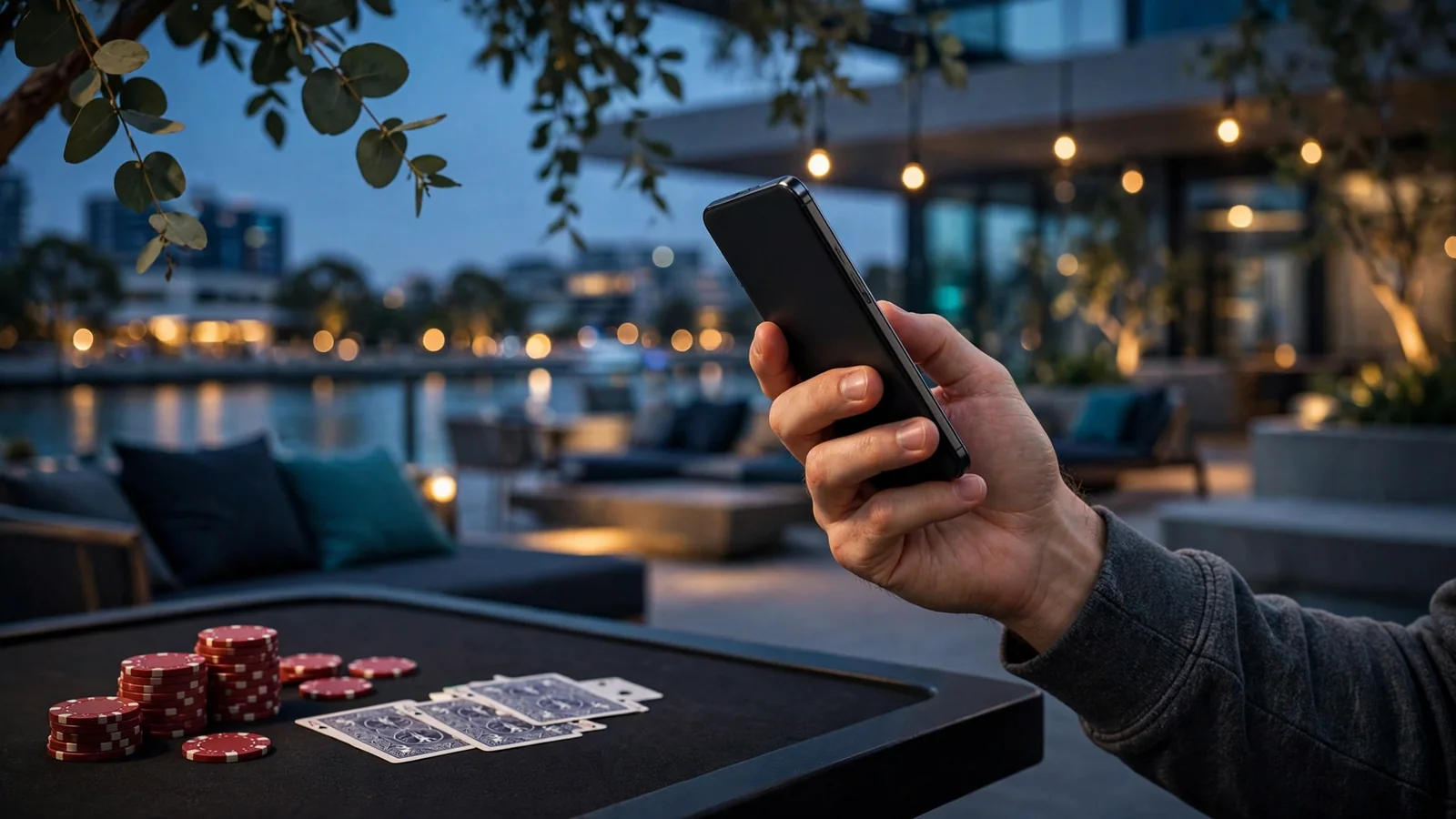
The Interactive Gambling Act 2001 places the relevant obligation on service providers. Online casino-style games—including slots, poker and table games—are prohibited interactive gambling services when offered to customers in Australia. A site’s polished design, familiar branding or functioning account area does not change that status. Nor does an overseas licence amount to Australian authorisation. The law draws its line around the service offered to people in the country, not the appearance of the website or the country in which its operator says it is based.
Connection is not permission.
That point can be obscured by the ordinary behaviour of the internet. A domain may open one day and fail to resolve later. A replacement address may appear, and an older address may remain visible in links, posts or saved account details. Australian internet service providers can be directed to block access to sites providing prohibited interactive gambling services or advertising them. Blocking can therefore change which addresses resolve on a particular connection; it does not convert an operator into a locally authorised casino.
Attention: The use of alternate domains or a functioning login screen does not establish an Australian licence or legal authorisation.
Regulatory enforcement records describe ACMA action against illegal gambling services that used alternate domains, including domains associated with Fair Go. That record is about enforcement, not an endorsement of a service or evidence that a replacement address has a different legal standing. The regulator’s role is federal: the Australian Communications and Media Authority enforces the Interactive Gambling Act and monitors compliance with the country’s interactive-gambling rules.
A block is also not a complete map of the internet. Its practical effect may be that a particular address cannot be reached through an Australian provider, while another address appears later. The shifting surface can give the impression that a service has simply moved house. Legally, a new domain is only a new address. It does not erase the nature of the service being provided, or establish that the service is permitted in Australia.
The distinction matters for anyone encountering a site described as a place to play casino games online. The wording may suggest a digital version of a physical gaming venue, but the two belong to different regulatory settings. Australian casinos operate under licences issued by their state or territory; that local venue framework does not extend into an online casino licence for offshore operators. The word “parlour” in a site name or description does not bridge the gap.
Nor does a successful account sign-in prove the point. Account traffic can continue to reach a website even where its services are prohibited, and the presence of a login screen says nothing about Australian approval. The same is true of an address that has not yet been blocked, or one that appears after another domain becomes inaccessible. Availability is a condition of access, not a finding by a regulator.
This is why domain changes should be understood as part of enforcement and connectivity, rather than as a reliable signal of legitimacy. ACMA can ask Australian internet providers to restrict access to prohibited gambling services and their advertising. The resulting pattern may be uneven from one address to another, and it may change over time. A moving target remains a target.
Free Chips and Spins: Search Terms, Not Verified Offers
“Free spins” and “free chips” belong to the vocabulary of casino promotion. Their appearance beside the name of a venue or service does not establish that an offer exists, that it is available in Australia, or that it comes from an authorised operator. The words describe an attraction being suggested; they do not prove that anything can be claimed.
That distinction matters because promotional language often travels farther than the promotion it describes. A phrase may appear in a page title, an advertisement, a copied listing or a discussion of an offer that has ended. Without reliable, current information identifying who made the claim and what it applies to, the phrase remains a claim on a screen. It is not a receipt.
The wording can also blur separate settings. A physical casino’s parlour is a place in a licensed venue; free chips and spins are commonly used to describe incentives associated with online casino-style play. Putting the terms together does not make the online service an extension of the physical room. Nor does a familiar venue name, used near promotional language, establish that the venue issued or approved it.
How promotional labels function
Phrases like “free spins” or “free chips” describe an attraction being suggested; they do not prove that an offer exists, is available in Australia, or comes from an authorised operator.
This is more than a matter of careful phrasing. Under the Interactive Gambling Act 2001, operators cannot provide real-money online casino games to people in Australia. Casino-style games such as slots and table games fall within the prohibited services when supplied to customers here. Advertising prohibited interactive gambling services is also banned. A “free” label does not, by itself, change the nature of the service being promoted.
The label can conceal important distinctions. It may suggest a gift, but it does not tell whether the wording refers to a real promotion, what activity it concerns, or whether any conditions apply. Those details cannot be inferred from the words “free chips” or “free spins” alone. Adding a casino name to the phrase does not fill the gaps.
Even the appearance of a functioning website is not proof. A site may load, accept account traffic or appear at another address without being an Australian-licensed online casino. The practical surface of the internet is a poor substitute for legal status. A page can look complete and remain outside the law.
For readers comparing promotional claims, the soundest distinction is between language and evidence. A search result can show that someone used a phrase; it cannot verify an offer or establish that an online casino service is lawful in Australia. The same caution applies when the wording is repeated across pages: repetition is not confirmation.
Free chips. Free spins. The words are easy to print. Their meaning depends on who is making the claim, what service it concerns and whether that service may lawfully be offered in Australia. Without those answers, the phrase is only promotional language, not a verified invitation.
A Bonus Is Not Evidence of a Licensed Casino
A bonus is a sales label, not a regulatory status. A site can describe a welcome credit, a deposit match or another incentive in polished language; none of those words establishes that the business is authorised to provide online casino services in Australia. The distinction matters because the Interactive Gambling Act 2001 prohibits operators from providing real-money online casino games to people physically located in the country.
Promotional language can make an offer feel official. It may be presented beside terms, account features or claims of customer support, creating the impression of a complete and orderly service. But presentation is not permission. Nor does a bonus become lawful because it is small, temporary, described as a reward, or attached to a familiar-sounding venue name. The label cannot change the legal character of the service behind it.
That is the narrow point behind phrases such as a bonus associated with a pokies parlour: the words alone tell nothing reliable about Australian authorisation. “Parlour” may evoke a physical gaming room, while “casino” suggests a venue with a local licence. Joined to “bonus”, the terms can still describe nothing more than an online promotion. Familiar vocabulary is not a licence.
The same caution applies when a website is reachable, accepts account traffic or appears at another web address. Those circumstances do not establish that it is an Australian-licensed online casino. Access is a technical condition; authorisation is a legal one. They are not interchangeable, however confidently a promotion is worded.
A physical casino and an online service also belong to different regulatory questions. Australian casino properties operate under licences issued by their state or territory. That local licensing framework does not make an online casino offer lawful, and a promotion cannot borrow legitimacy from the name of a land-based venue. The difference is less glamorous than the wording on a banner. It is more consequential.
Regulatory Status
A promotional bonus is a sales inducement and cannot serve as evidence of a licensed casino operation in Australia.
Promotional language is designed to draw attention to an apparent benefit. It is not designed to settle the legal status of the operator. In Australia, where real-money online casino services are prohibited, a bonus claim is particularly poor evidence of permission: it describes an inducement, not an authorised service.
A promise is not a permit.
Parlour Pokies in the Casino Setting
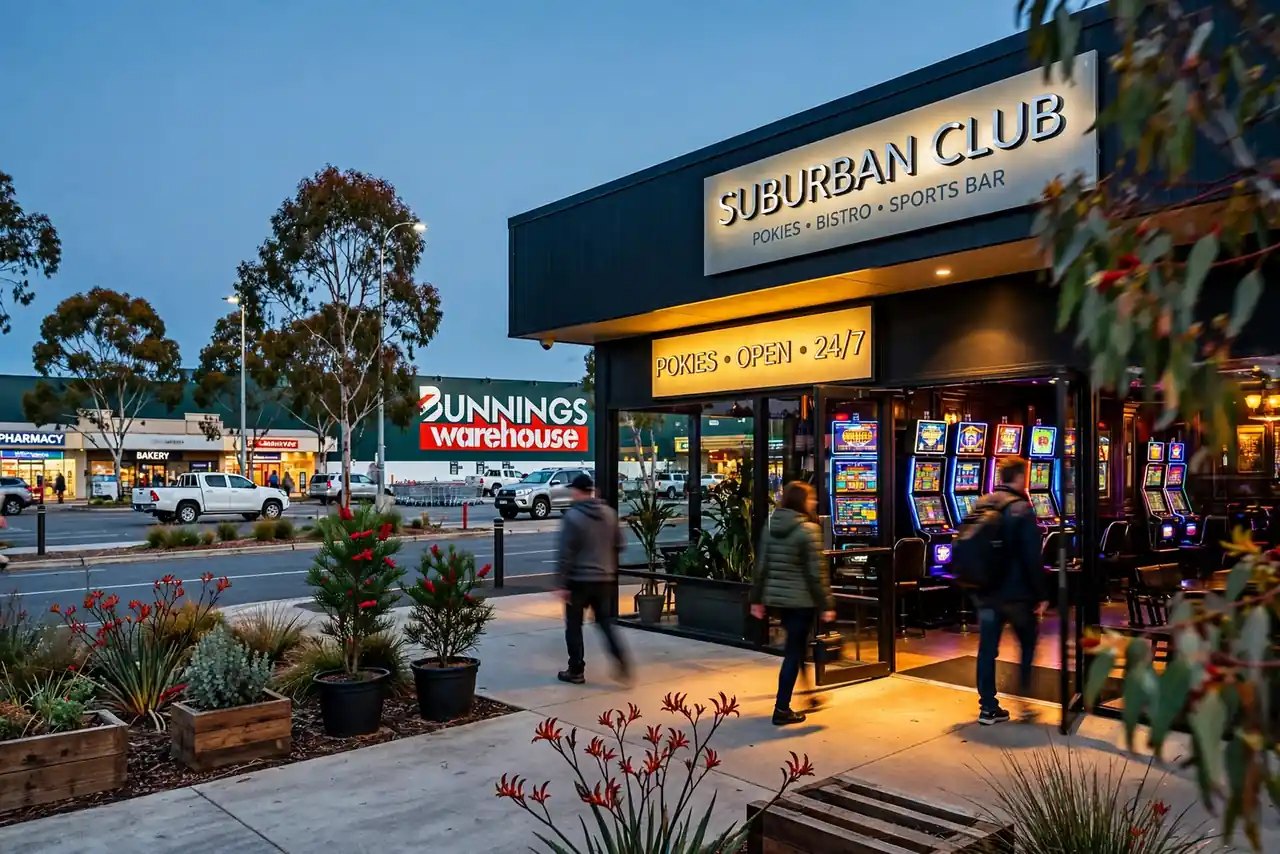
The language of a “parlour” can make casino machines sound like a separate kind of venue: a room with its own social habits, set apart from the larger property around it. In practice, the phrase points to a familiar part of the casino floor, not necessarily to a distinct business or a standalone place. The setting matters. A machine inside a casino belongs to a venue licensed and governed within its state or territory.
Across Australian casinos, 3,308 gaming machines are endorsed on venue licences and installed. That national figure gives the parlour idea a useful scale, but it is not a count of rooms, individual properties or people who use them. It describes machines recorded in the casino setting. The distinction is plain, if less dramatic than the phrase.
A parlour suggests intimacy; a casino is a regulated property with a much wider institutional frame. The small word carries a social picture, while the licence carries the legal one. Neither should be mistaken for the other. The machines are part of the country’s land-based casino landscape, not evidence of a separate category of venue.
That difference also keeps the discussion grounded. A local name for a room or area may vary, but the national count concerns licensed casino installations. It does not tell how a particular property arranges its floor, nor does it establish that every casino uses “parlour” as an official label. The phrase is best understood as a casual description of casino machines in a venue, rather than a technical classification.
There is a modest lesson in the terminology: familiar words often make a regulated system seem more domestic than it is. The parlour sounds private and informal. The licence is neither.
Real-Money Casino Searches and What They Establish
The phrase “real-money casino” makes a commercial claim, not a legal one. It describes the kind of play being offered: games in which money is staked or won. It does not establish that the service is authorised for people in Australia, however polished its presentation or familiar its language.
The distinction matters because the Interactive Gambling Act 2001 prohibits operators from providing real-money online casino games to people physically located in Australia. That includes online slots, poker and table games such as blackjack and roulette. The prohibition concerns the service itself; a label on a page cannot turn a prohibited service into a lawful Australian one.
A land-based casino and an online casino may share vocabulary while belonging to different regulatory worlds. Australian casino properties operate under licences issued by their state or territory. That local licensing framework does not create an equivalent permission for online casino operators to serve Australian customers. Similar names, images or promises do not bridge the gap.
Nor does a site’s apparent operation settle the matter. Being reachable, receiving account activity or appearing at another web address is not evidence of an Australian licence. Those are signs of access or activity, not proof of legal standing. The distinction is deliberately less glamorous than the sales language.
The Act places the legal obligation on operators: providing prohibited online casino services to people in Australia is illegal. A player does not incur a fine or criminal prosecution merely for playing at an offshore casino without a local licence. That does not make the operator’s service lawful, or its claims reliable.
“Real money” can therefore identify the nature of an offer, but not its Australian authorisation. The phrase says what the service purports to do. It says nothing, by itself, about whether that service may lawfully be provided here.
Published by the Big Candy Casino team.