A Big Candy Australia Guide
A Big Candy Payment Methods and Deposits in Australia
 Available in US
A Big Candy currently shows three deposit methods on its official banking page: Visa/MasterCard, Neosurf and Bitcoin. All three show a $30 minimum deposit. Visa/MasterCard carries a 2% deposit fee, while the banking table marks Neosurf and Bitcoin as free at the casino level. The same table shows different maximums: $100 per card transaction, $500 for Neosurf and $1,000 for Bitcoin. Australian readers should not assume that locally familiar options such as PayID or mobile wallets are also A Big Candy methods. They are common in Australia, but they are not listed on the current official A Big Candy banking page. That distinction matters when checking which methods are actually available at A Big Candy.
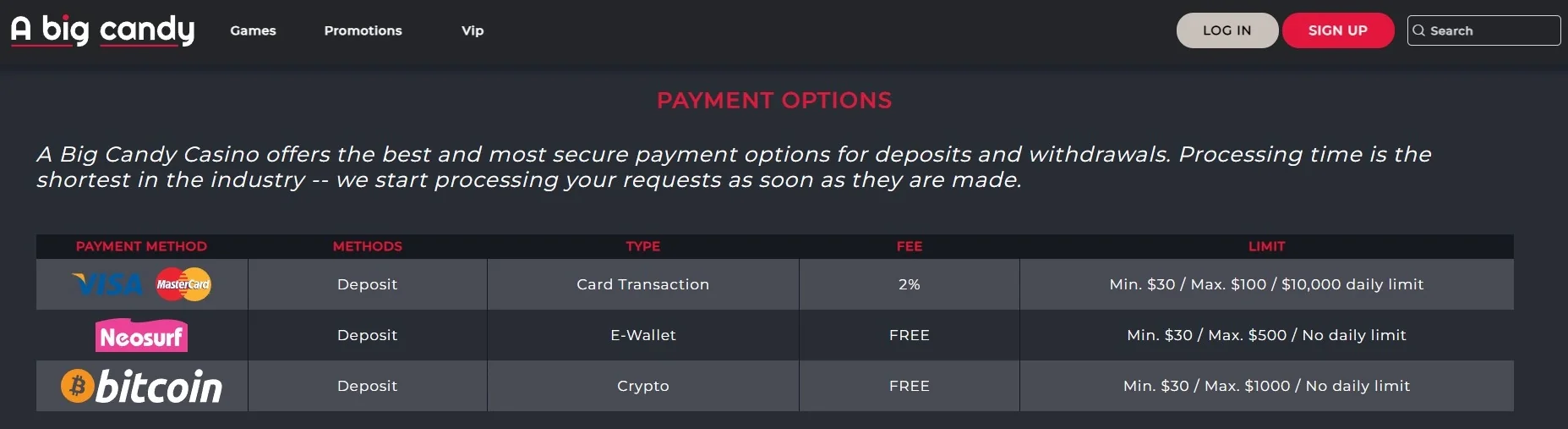
Table of Contents
- Current A Big Candy deposit methods at a glance
- The $30 minimum deposit is consistent across the listed methods
- Visa and Mastercard: familiar, but the fee changes the cost
- Neosurf: a higher listed transaction maximum and no casino fee
- Bitcoin: the listed crypto option, not proof of broad crypto support
- Why PayID and mobile wallets need a separate Australian reality check
- Transaction maximum and daily limit are not the same thing
- Deposit choice affects later cashier friction
- What the public banking page does not prove
- A practical deposit checklist for Australian readers
- Which payment options make the most sense?
Current A Big Candy deposit methods at a glance
The public banking page presents a narrow cashier rather than a long catalogue of cards, bank transfers, e-wallets and cryptocurrencies. That makes the listed methods easy to verify. Visa/MasterCard is the card option, Neosurf is listed as an e-wallet, and Bitcoin is the crypto option. The page does not currently show PayID, Skrill, Neteller or a broad list of alternative coins.
| Method | Type | Minimum | Maximum shown | Daily limit shown | Casino fee |
|---|---|---|---|---|---|
| Visa/MasterCard | Card transaction | $30 | $100 per transaction | $10,000 | 2% |
| Neosurf | E-wallet | $30 | $500 | No daily limit shown | Free |
| Bitcoin | Crypto | $30 | $1,000 | No daily limit shown | Free |
The wording matters. “No daily limit shown” describes what appears on the current casino table; it is not a promise that an external payment processor can never impose its own restriction. The casino’s finance terms say payment processing is handled by the casino or a payment processor and that processor limitations can affect financial transactions. The table therefore gives the public casino limits, while processor-specific availability can still matter at the point of payment.
The $30 minimum deposit is consistent across the listed methods
The public minimum deposit is $30 for Visa/MasterCard, Neosurf and Bitcoin. This is useful because it removes one common comparison problem: a reader does not need a different entry threshold simply because they choose one of the three listed methods. Instead, the more important differences are the maximum shown for each method and whether a casino fee applies.
For card deposits, the current table shows a $100 per-transaction maximum and a $10,000 daily limit. Neosurf shows a $500 maximum, while Bitcoin shows a $1,000 maximum. Neither Neosurf nor Bitcoin displays a daily limit in the table. These are current public cashier values, not a guarantee that every transaction will be accepted by a processor or issuer.
The $30 minimum is also relevant when comparing deposit promotions, because several current A Big Candy promo codes use the same threshold. The separate A Big Candy bonus guide deals with those offer-specific terms. For banking, the relevant points are the methods shown in the cashier and their current public limits and fees.
Visa and Mastercard: familiar, but the fee changes the cost
Cards are the most familiar option for many Australian consumers, and the A Big Candy cashier does list Visa/MasterCard. The important detail is the 2% fee. A deposit method can be convenient while still carrying a higher direct cost than alternatives marked free by the casino.
The current banking table shows a $30 minimum and a $100 maximum per card transaction, plus a $10,000 daily limit. The finance terms separately state that a 2% transaction fee applies to deposits made using a credit card. That means a reader comparing methods should treat the card fee as part of the deposit cost rather than focusing only on whether the card is accepted.
There is also a documentation point tied specifically to credit-card use. The finance terms state that the casino requires an authorisation form and a front copy of the credit card when a player deposits by credit card. That requirement belongs to the payment method and should not be broadened into a universal KYC checklist for every depositor. The dedicated A Big Candy KYC covers verification in its proper context.
Neosurf: a higher listed transaction maximum and no casino fee
Neosurf is the second method on the current banking table. The casino labels it as an e-wallet, shows a $30 minimum, a $500 maximum and no daily limit, and marks the casino fee as free. Compared with the card row, the listed maximum is higher and the casino does not show a deposit fee.
That does not mean Neosurf is automatically the best choice for every reader. The useful comparison is narrower: on the casino’s public table, it has a larger listed maximum than Visa/MasterCard and no casino fee. A player still needs to consider whether they can actually use the method, whether an external provider has separate rules, and how they intend to handle later withdrawals and verification.
This is also why a long affiliate-style list of e-wallets would be misleading here. The current official surface names Neosurf, not a broad group of wallets. If another wallet is not visible on the live cashier and is not confirmed by a current reliable source, it should not be treated as supported.
Bitcoin: the listed crypto option, not proof of broad crypto support
Bitcoin is the crypto method currently shown on the public banking page. The table lists a $30 minimum, a $1,000 maximum, no daily limit shown and no casino fee. Those are the values shown in the current banking table.
What the table does not establish is just as important. It does not verify a broad set of altcoins. Other listings may mention additional coins, but the current official cashier is narrower. The supported conclusion is that Bitcoin is listed; broader cryptocurrency support should not be assumed unless the official banking page adds other assets.
Bitcoin also should not be treated as a shortcut around account checks. The A Big Candy withdrawals has its own review, documentation and processing terms. Choosing crypto for a deposit does not remove the separate requirement to have a verified account before a withdrawal request can be processed.
Why PayID and mobile wallets need a separate Australian reality check
Australian payment habits create a strong temptation to assume that a locally popular method will appear in every online cashier. The Reserve Bank of Australia’s 2025 Consumer Payments Survey shows why that assumption feels natural. Cards accounted for 73% of consumer payments, debit cards for 49% and credit or charge cards for 23%. Mobile-wallet adoption continued to rise, with 43% of consumers using a mobile device for a contactless payment during the survey diary week. Around half of respondents reported using PayID during the prior year.
Those figures describe Australian consumer behaviour. They do not describe A Big Candy’s cashier. The current A Big Candy banking page lists Visa/MasterCard, Neosurf and Bitcoin. It does not list PayID or a mobile-wallet method. A useful Australian payment comparison therefore has to keep two questions separate: “What do Australians commonly use?” and “What does this casino currently support?” Only the second question can establish a brand-specific payment method.
PayID may be popular in Australia, but that does not mean A Big Candy accepts it. PayID remains unverified as a current A Big Candy payment method.
Transaction maximum and daily limit are not the same thing
The card row illustrates why cashier limits need to be read by level. A $100 maximum per transaction does not mean the public table limits all card deposits to $100 in a day, because the same row separately shows a $10,000 daily limit. The two figures control different things. By contrast, the Neosurf and Bitcoin rows show their own maximum values and say no daily limit is shown.
This distinction helps avoid another common review shortcut: quoting the largest number in a row without explaining what it applies to. A transaction maximum describes one deposit attempt, while a daily limit describes cumulative activity over a day. Processor checks can still affect whether a particular transaction is accepted, so the table should be read as the casino’s published cashier framework rather than a guarantee of processing capacity.
Deposit choice affects later cashier friction
A deposit is only one side of the cashier decision. The casino’s finance terms make clear that payment processors can impose limitations and that the withdrawal process has its own review and documentation requirements. That means the most convenient deposit method is not necessarily the one that creates the simplest overall account journey.
Before depositing, it is sensible to check three separate layers. First, confirm the method and current limits on the banking page. Second, understand whether your chosen funding route creates extra documentation, as credit-card deposits can. Third, read the withdrawal process before assuming that a successful deposit predicts a fast payout.
The dedicated A Big Candy withdrawal limits covers weekly cashout caps separately, because those limits are not deposit-method limits. Keeping those topics separate makes it easier to see what each number actually controls.
What the public banking page does not prove
The banking page is useful because it gives a compact verified table, but it should not be stretched beyond what it shows. It does not provide a complete public list of withdrawal methods. It does not verify PayID, Skrill, Neteller or a set of alternative cryptocurrencies. It does not guarantee that every processor will accept every transaction. It also does not remove account-verification requirements that apply later in the customer journey.
This is an important practical rule. When a casino’s current official cashier is narrower than lists published on review sites, the official surface should control the current method list. Older or broader third-party data can be useful for discovery, but it should not be upgraded into a current brand claim when the live banking page does not support it.
A practical deposit checklist for Australian readers
- Confirm that the method you plan to use is currently visible on the official A Big Candy banking page.
- Check the $30 minimum against the amount you actually intend to deposit.
- For Visa/MasterCard, include the 2% fee in the cost comparison and note the card-specific documentation clause.
- For Neosurf and Bitcoin, read “no daily limit shown” as a casino-table statement, not a universal processor guarantee.
- Do not assume PayID or a mobile wallet is supported just because it is common in Australia.
- Read the withdrawal and KYC pages before depositing so later requirements are not a surprise.
If you are starting from the account side rather than the cashier, the registration and login explains the Inclave account flow. For a broader decision about product quality, banking, regulation and trust, return to the A Big Candy Australia review.
Which payment options make the most sense?
The current published deposit list is concise: Visa/MasterCard, Neosurf and Bitcoin, each with a $30 minimum. Cards show a $100 per-transaction maximum, a $10,000 daily limit and a 2% fee. Neosurf shows a $500 maximum, Bitcoin a $1,000 maximum, and both are marked free by the casino with no daily limit shown.
For Australians, the most useful conclusion is not that the cashier mirrors local payment habits. It does not. Cards are familiar, but PayID and mobile wallets are not verified as current A Big Candy methods. Treat the official banking page as the brand-specific primary reference, and treat Australian payment statistics as context rather than evidence of casino support. If trust and operator history matter as much as payment convenience, the trust and reputation puts the cashier facts into the wider evidence picture.
Written by the editors at Big Candy Casino.