A Big Candy Australia Guide
Why ACMA Blocked A Big Candy: June 2024 ISP Action
 Available in US
On 20 June 2024, the Australian Communications and Media Authority (ACMA) announced that it had requested Australian internet service providers to block A Big Candy, alongside Jackpoty and John Vegas Casino. ACMA said its investigations found the listed services were operating in breach of the Interactive Gambling Act 2001. For an Australian reader, that is a direct regulator enforcement fact, not a review-site opinion. Website blocking is one of ACMA’s tools for disrupting prohibited or unlicensed online gambling services. It does not, by itself, prove that every A Big Candy URL, mirror or future domain is blocked at every moment, and it should not be turned into an unsupported claim that an individual player commits a criminal offence simply by visiting the site. The practical point is narrower: ACMA has specifically acted against A Big Candy as an online gambling service offered into Australia. For the broader provider-side rules, see our Australian legal status guide.
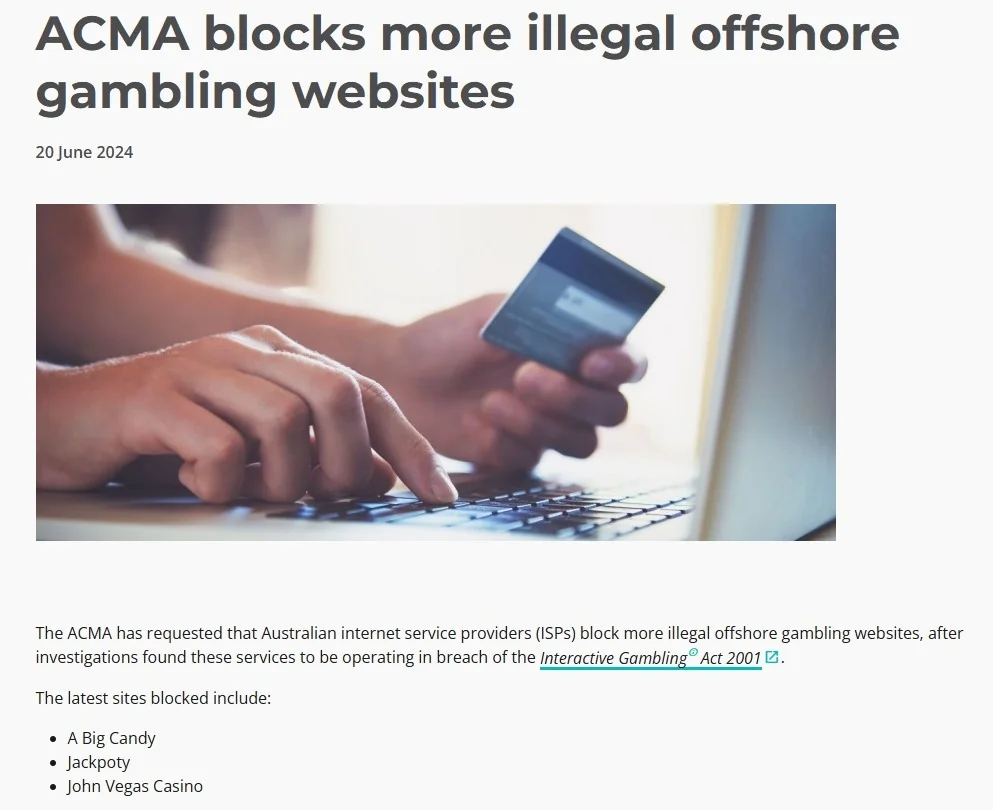
Table of Contents
- What ACMA said on 20 June 2024
- How website blocking fits into ACMA’s enforcement framework
- What the A Big Candy block proves – and what it does not
- Blocking and licensing answer different questions
- Why a 2024 action is still relevant in 2026
- How to use this information in a trust decision
- A short timeline of the evidence
- Frequently asked questions
- What the ACMA blocking action means
What ACMA said on 20 June 2024
The primary source is ACMA’s article “ACMA blocks more illegal offshore gambling websites”. It states that ACMA requested Australian ISPs to block more illegal offshore gambling websites after investigations found the services operating in breach of the Interactive Gambling Act 2001. A Big Candy appears by name in the short list of sites included in that action.
That wording matters. The regulator did not merely publish a generic warning about offshore casinos. It identified A Big Candy in a dated enforcement announcement and tied the action to an investigation under the IGA. This is stronger evidence than an affiliate review, search snippet or user comment because it comes directly from the Commonwealth regulator responsible for enforcing the interactive gambling framework.
The page also explains ACMA’s consumer-protection rationale. At the time, ACMA said website blocking was one of a range of enforcement options used against illegal online gambling and warned that services outside the legal Australian framework may not provide the same customer protections as licensed Australian wagering services. That statement should be read as regulatory context, not as evidence that every customer necessarily loses money or that every disputed payout has the same cause.
How website blocking fits into ACMA’s enforcement framework
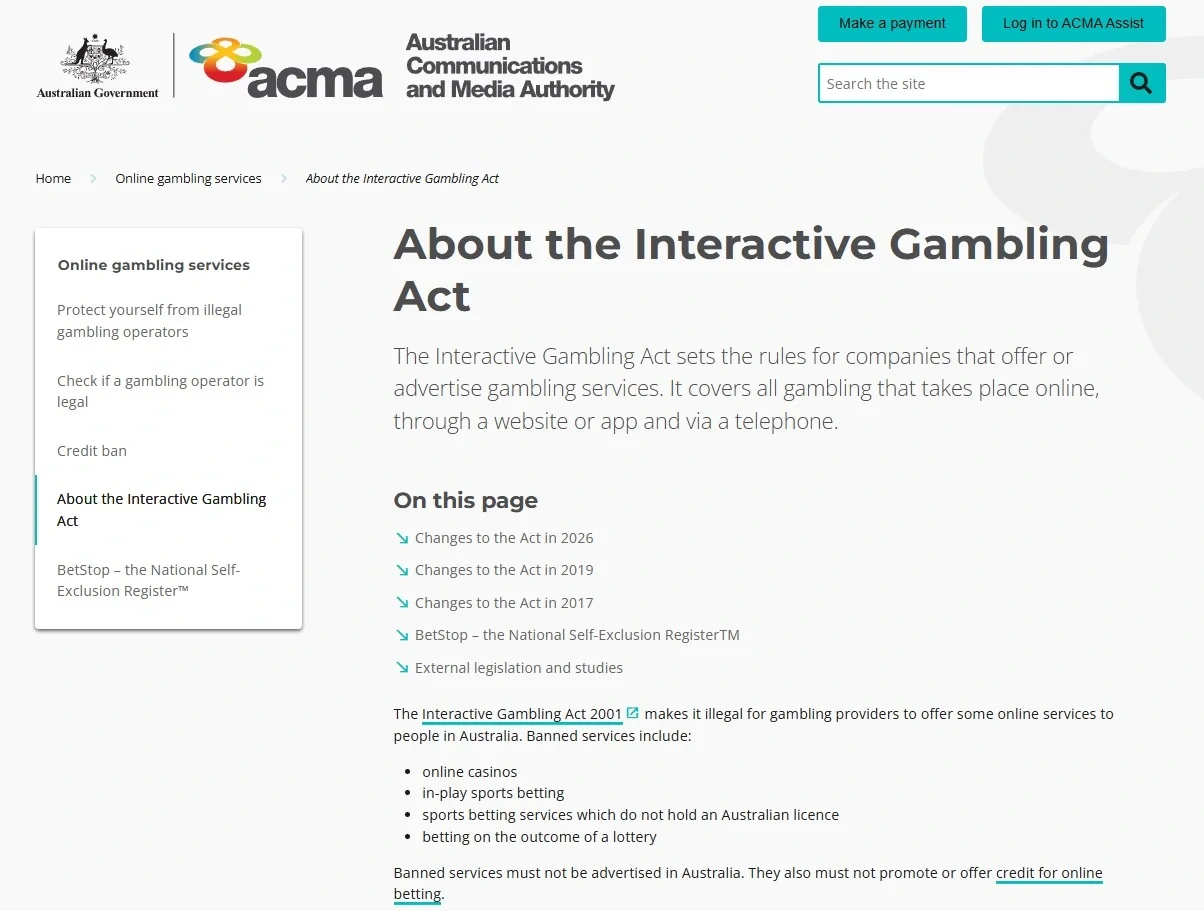
ACMA’s current blocked gambling websites guidance explains that the regulator can ask ISPs to disrupt access to websites in circumstances involving serious civil or criminal offences. For gambling, ACMA gives examples that include providing prohibited interactive gambling services to customers in Australia, providing an unlicensed regulated interactive gambling service, and publishing advertisements for prohibited or unlicensed regulated services.
The underlying service category is important. ACMA’s current Interactive Gambling Act guidance says online casinos are banned services for providers to offer to people in Australia. That is different from the Australian licensed online wagering market, where eligible wagering providers operate under state or territory licences and appear on the ACMA licensed-provider register. A Big Candy’s June 2024 action therefore sits in the prohibited online-casino enforcement context, not in a routine dispute over the conditions of an Australian wagering licence.
Blocking is also only one enforcement mechanism. ACMA can investigate services, issue formal warnings and use other regulatory measures. The scale of ongoing activity shows that website blocking is not a one-off historical tactic. In its April to June 2026 enforcement report, ACMA recorded 30 completed investigations into 76 gambling sites, 56 IGA breaches, 18 formal warnings and 187 website referrals to ISPs for blocking. Those 2026 figures are broader regulatory context and are not a claim that all 187 referrals involved A Big Candy.
What the A Big Candy block proves – and what it does not
| Question | What the evidence supports | What should not be inferred |
|---|---|---|
| Did ACMA act against A Big Candy? | Yes. ACMA named A Big Candy in its 20 June 2024 ISP-blocking announcement. | Do not reduce this to an anonymous or third-party allegation. |
| Why did ACMA request blocking? | ACMA said investigations found the listed services operating in breach of the Interactive Gambling Act 2001. | Do not invent a different statutory finding or a private dispute that ACMA did not state. |
| Does the action mean every current domain is blocked? | No such blanket technical claim is established by the 2024 article. | Do not claim all mirrors, domains or access routes are currently blocked everywhere in Australia. |
| Does the action prove player criminal liability? | No. The relevant primary sources concern provider-side prohibitions and regulator enforcement. | Do not turn a provider-side rule into an unsupported statement that an individual player commits an offence merely by accessing a site. |
| Does the action establish an Australian licence? | No. The current ACMA licensed-provider register has no matching A Big Candy entry. | Do not confuse enforcement against a service with licensing of that service. |
Blocking and licensing answer different questions
The June 2024 block and the Australian licence check are related, but they are not interchangeable. The blocking action answers a historical enforcement question: did ACMA identify and act against this service under the IGA framework? The answer is yes. The register check answers a current licensing question: does A Big Candy appear in ACMA’s register of licensed interactive gambling providers? The 8 September 2026 register check found no matching A Big Candy, Big Candy or abigcandy entry.
That is why the site’s A Big Candy licence page treats local licensing as a separate evidence stream. It does not infer a specific offshore licence from the Australian no-hit result, and it does not let an offshore licence claim erase the Australian enforcement record. Each question has its own source and its own scope.
The same separation helps avoid a common review-site error. A functioning website, cashier or customer-support channel is evidence that a product feature exists; it is not evidence of Australian regulatory approval. Conversely, an ACMA blocking action does not make independently verifiable product details disappear. Regulatory status, payment mechanics, games, promotions and support are distinct factual dimensions.
Why a 2024 action is still relevant in 2026
The event is dated, but the regulator record remains decision-relevant because it documents how ACMA treated the brand. A reader assessing a casino today should distinguish three timelines: the 20 June 2024 brand-specific action, the current 2026 legal and enforcement framework, and whatever technical access the reader experiences at this moment. ACMA records establish the first two; moment-to-moment technical access is a separate question. A successful or failed attempt to load one domain is not a substitute for the regulator record.
ACMA’s current blocking guidance, last updated in 2026, still describes ISP blocking as an active enforcement tool. Its April to June 2026 report also shows continued use of referrals at scale. That makes the 2024 A Big Candy event more than an isolated old search result: it sits within a continuing enforcement program.
At the same time, blocking status can change. Domains can change, operators can rebrand, and blocking lists can evolve. That does not establish that a particular A Big Candy URL is technically unreachable from every Australian network today. The verifiable claim is the regulator action itself. Readers who need the latest technical blocking list should use ACMA’s current blocked-sites page rather than relying on an old saved image or a review article.
How to use this information in a trust decision
An ACMA block is a high-weight Australian regulatory signal because it comes from the regulator and names the brand. It should be considered alongside, rather than blended into, other evidence. The current Australian licence register does not show A Big Candy. Official casino terms publish withdrawal review periods, limits, fees and verification requirements. Independent review platforms add secondary reputation signals. None of those categories should be substituted for another.
A practical due-diligence sequence is to start with the regulator record, then inspect the casino’s current withdrawal and verification terms, then look at independent complaint patterns for issues that match those terms. If a complaint says a withdrawal took a long time, for example, compare that allegation with the official published review and post-approval processing windows rather than treating the complaint alone as proof of non-payment. The dedicated trust and reputation page performs that evidence-layering exercise.
For the blocking event itself, there is no need to search for workarounds. VPN instructions, mirror domains, DNS changes and other methods intended to bypass ISP controls are not provided here. The useful question is what the enforcement record says about regulatory risk, not how to evade the measure.
A short timeline of the evidence
20 June 2024
ACMA announces an ISP-blocking request that names A Big Candy and states that investigations found the listed services operating in breach of the IGA.
20 July 2026
ACMA’s current blocked-gambling guidance continues to describe website blocking as an enforcement tool for prohibited and unlicensed gambling services.
April to June 2026 reporting period
ACMA reports 30 investigations, 56 IGA breaches, 18 formal warnings and 187 websites referred to ISPs for blocking across its broader enforcement program.
8 September 2026 register check
The current licensed-provider register contains no matching A Big Candy, Big Candy or abigcandy entry.
Frequently asked questions
Was A Big Candy actually named by ACMA?
Yes. The regulator’s 20 June 2024 article lists A Big Candy by name among the sites in that ISP-blocking action.
Does the block mean A Big Candy is licensed somewhere else?
No. A blocking action does not establish an offshore licence. The current Australian register check and any offshore licence verification are separate tasks.
Is the A Big Candy website definitely blocked on every Australian connection today?
The 2024 regulator article does not support that blanket technical statement. It confirms the blocking request and the regulator finding, not universal present-day reachability of every possible domain.
Where can I read the full Australia-specific legal context?
Use the IGA rules page for the provider-side legal framework, current ACMA guidance and the timing of the 2026 reforms.
What the ACMA blocking action means
The verified point is straightforward: ACMA requested Australian ISPs block A Big Candy on 20 June 2024 after finding the service operating in breach of the Interactive Gambling Act. The current regulatory framework still treats online casinos as a prohibited service for providers to offer to people in Australia, and ACMA continues to use website blocking as an enforcement tool. That is a meaningful regulatory signal for an Australian reader, but it should be stated precisely. It is not proof that every current domain is unreachable, it is not an Australian licence record, and it is not a basis for inventing player-level criminal liability. For a broader view of the brand, start with the full A Big Candy review and then weigh the regulator record together with current terms and reputation evidence.
Prepared by the Big Candy Casino editorial staff.